Effort Is a Feature, Not a Bug
Somewhere in the proliferation of modern Dharma, a misunderstanding took hold: that the goal of practice is to stop trying. Do nothing. Relax into what is. Let it all happen on its own.
This sounds liberating. It is also a dead end.
The Do-Nothing Misunderstanding
The instruction to "do nothing" addresses something real. There is a kind of effort in practice that is counterproductive — a straining, grasping, micromanaging effort that insists experience conform to what we have decided it should be. This is the effort of performance: forcing calm, manufacturing concentration, holding the body rigid in the posture of someone who is definitely meditating.
That kind of effort is a problem. But the conclusion that effort itself is the problem — that is the misunderstanding.
Any practice you step into — traditional lineage, monastery, modern program — involves exertion. This is unavoidable. You are a conditioned being. Your patterns are deeply grooved. The momentum of how you have been becoming runs in a single direction, and changing that direction requires energy. The question is not whether to effort, but how.
Two Kinds of Effort
There is strainful effort and there is virtuous exertion. They feel different, they function differently, and confusing them derails practice in both directions.
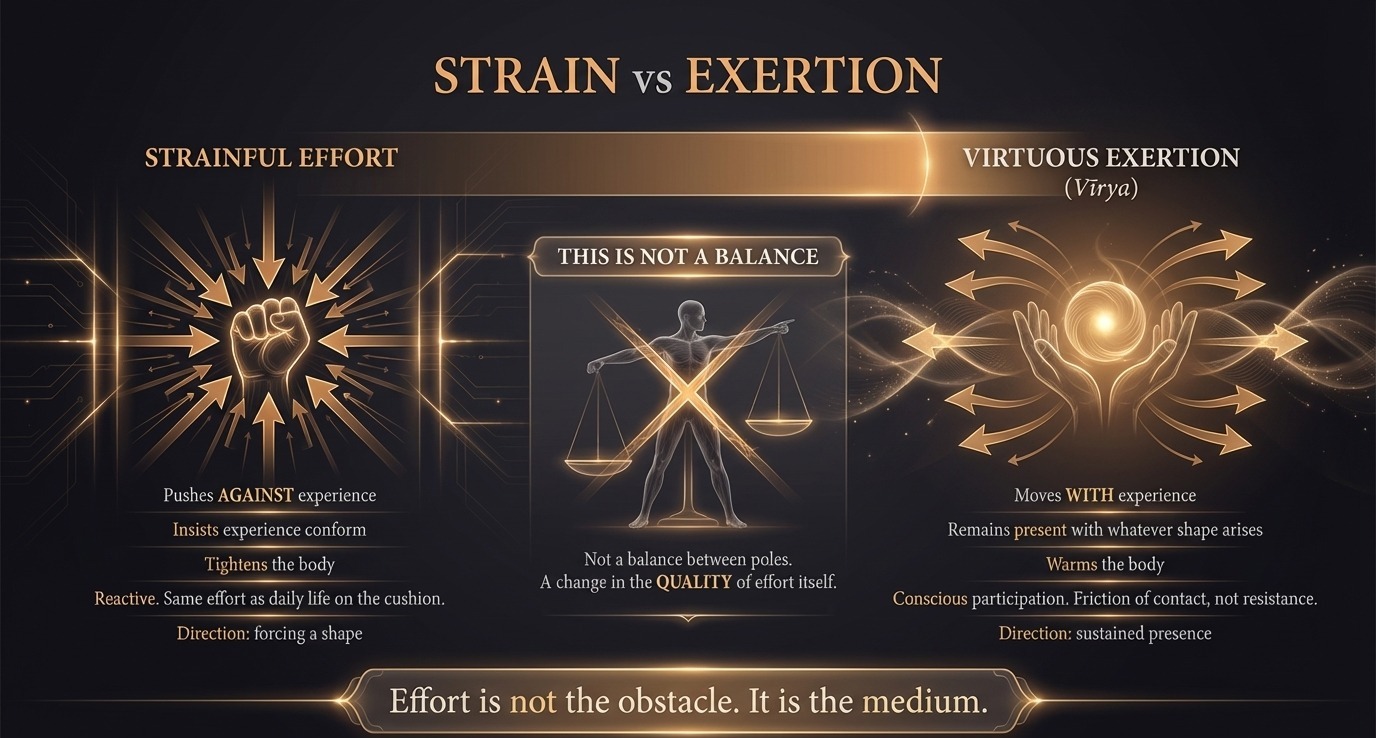
Strainful effort is the effort of insistence. You decide what a good sit looks like — calm, focused, blissful — and then you force your experience toward that image. When thoughts arise, you suppress them. When restlessness shows up, you clamp down. When the mind wanders, you yank it back like a dog on a leash. This effort is reactive. It is the same effort you use in daily life to hold it all together, imported onto the cushion under the guise of discipline.
Virtuous exertion — what the tradition calls vīrya (energy, vigor) — is something else. It is the energy of conscious participation. Not forcing experience into a shape, but actively choosing to remain present with whatever shape experience takes. It includes the willingness to stay when the system says leave, to soften when the impulse is to tighten, to meet what is uncomfortable without redirecting to what is safe.
The difference is not in the amount of energy expended. It is in the direction. Strainful effort pushes against experience. Virtuous exertion moves with it — fully engaged, fully present, and fully accountable for what arises.
Rest Is Not Relaxation
Here is where the confusion deepens. If effort is unavoidable, then rest must also be part of the training. But rest, in this context, does not mean what you think it means.
You have likely conflated rest with relaxation — with collapsing the tension, going limp, switching off. This conflation comes from being so identified with the strain of holding it all together that the only alternative you can imagine is release. Either you are gripping or you are not. On or off.
But rest is active. Think of a professional athlete. Rest and recovery are not the absence of training — they are part of the training. They require conscious intention, full presence, and genuine engagement with the body's actual state. An athlete who "rests" by numbing out is not recovering. They are dissociating.
The same applies on the cushion. Rest is the conscious participation in not insisting. It is not spacing out, not going blank, not drifting into a pleasant fog. It is the active choice to allow experience to cohere without your management — while remaining fully present with whatever coheres.
This distinction matters because the two exits from strainful effort both miss the mark. You can double down and grind harder — insisting with more force, concentrating with more tension, treating practice like a contest of will. Or you can collapse into passivity — "doing nothing" in the dissociative sense, letting the mind drift wherever it wants under the banner of non-effort.
Neither is the training.
The Middle That Is Not a Middle
The training is not a balance between effort and non-effort. It is not finding some moderate amount of trying that splits the difference. That framing preserves the same dualistic structure — too much effort on one end, too little on the other, and you somewhere in the middle trying to calibrate.
The shift is more fundamental than calibration. It is a change in the quality of effort itself. When you are no longer insisting that experience be a particular way, the energy that was consumed by insistence becomes available for something else: sustained, conscious presence. Not gripping. Not collapsing. Participating.
This feels different in the body. Strainful effort tightens. Virtuous exertion warms. When you are genuinely exerting — remaining present with the full field, including the discomfort, including the desire to check out — there is a quality of heat, of friction, that is not the friction of resistance but the friction of contact. You are actually touching your experience rather than managing it from a distance.
That friction is a feature. It means you are doing the work.
The Ongoing Refinement
As practice matures, the quality of effort continues to shift. What was once a deliberate, conscious choosing becomes increasingly natural — not because effort disappears, but because the system has been reconditioned to exert in a different way. The grooves of insistence loosen. The grooves of presence deepen. And the energy that used to leak through management and resistance is now available for a more sustained engagement.
But this refinement never ends. There is always a subtler form of insistence to discover, a more refined form of performance to see through. The practice is not to arrive at effortlessness. It is to become increasingly honest about where effort is still being misdirected.
Effort is not the obstacle. It is the medium. What matters is whether you are straining against experience or exerting to remain in it.
Continue learning: Illumination 101
A 10-day course for practitioners who have the maps but haven't yet inhabited the territory.
Start the course →