
Pacing: Why Harder Practice Isn't Better Practice
You did a ten-day retreat last year. Something cracked open on day seven -- genuine stillness, a quality of contact you had never touched before. You came home and sat ninety minutes a day for two weeks. Then you missed a day. Then three. By the end of the month you were back to sporadic sits and a low hum of self-reproach. The opening receded into narrative, something you describe at dinner parties but no longer inhabit.
The standard move is to blame yourself. Not enough discipline, not enough commitment, not enough fire. So you sign up for another retreat, hoping the intensity will reignite what faded. This is how serious practitioners spend a decade: sprinting, collapsing, and interpreting the collapse as evidence of insufficient effort.
It is not an effort problem. It is a pacing problem.
The Athletic Analogy That Actually Holds
Athletes understand something contemplative culture has largely ignored: the relationship between intensity, volume, and recovery is not optional. It is the entire architecture of training.
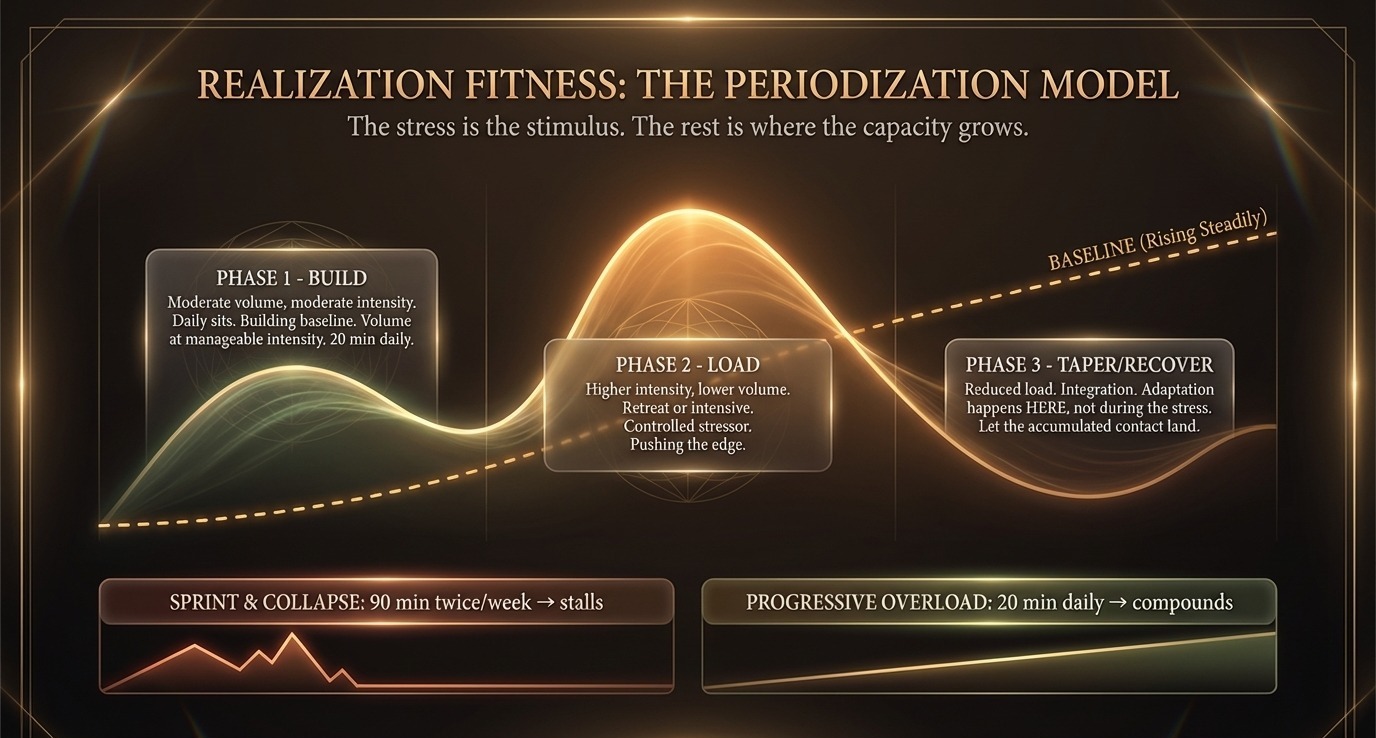
A competitive lifter does not walk into the gym and attempt a personal record every session. The training moves in cycles -- weeks of building volume at moderate intensity, followed by weeks of increasing load while dropping volume, followed by a deliberate taper where both intensity and volume reduce. The adaptation does not happen during the lift. It happens during the recovery. The stress is the stimulus. The rest is where the growth occurs.
This is not a metaphor. Your nervous system follows the same logic. Every genuine sit is a controlled stressor -- you are asking your system to sustain contact with experience it would normally exit. That contact requires voltage. And voltage is built through progressive overload and adequate recovery, not through heroic single efforts followed by collapse.
The stress is the stimulus. The rest is where the capacity grows.
What Overtraining Looks Like on the Cushion
In physical training, overtraining has clear markers: chronic fatigue, declining performance, irritability, injury.
Contemplative overtraining has its own signature. You push through a difficult sit and feel expanded, so you extend the session. You have a strong experience on retreat and try to replicate it at home by doubling your daily practice. The momentum tells your mind to keep going -- strike while it is hot, do not waste this opening.
And for a while, it works. But then the system reports the accumulated debt. You crash. You get sick the week after retreat. Your sits become flat and forced. You interpret this as regression when it is actually your system doing what an overtrained body does -- shutting down to protect itself from further depletion.
The paradox: the moment of peak momentum -- when everything feels alive and you want to train harder -- is precisely when intelligent pacing requires restraint.
Twenty Minutes Beats Ninety
No retreat centre puts this on its brochure: twenty minutes daily will outperform ninety minutes twice a week. Every time.
This is not a concession to busy schedules. It is a training principle. The container is built through repetition, not peak experiences. Each time you sit -- even briefly, even poorly -- you are laying down another repetition in the nervous system's capacity to sustain contact. The wiring thickens not through occasional surges but through consistent, moderate current.
The practitioner who sits twenty minutes every morning for six months has built something the retreat-hopper has not: a baseline. A floor of capacity that does not depend on external conditions or the momentum of an intensive. That baseline is where the real training lives -- available on the Tuesday morning when nothing feels special and the mind is full of grocery lists.
Capacity is built through repetition, not peak experiences.
The Taper Is the Training
In athletic periodization, the taper is the phase where you deliberately reduce training load before a peak performance. It is counterintuitive -- you feel like you should be doing more, and instead you are doing less. Athletes report that tapering is psychologically harder than the high-intensity phases. There is a sense of lost purpose, a restlessness, an anxiety that backing off means losing ground.
The same dynamic operates in practice. When you have been sitting intensely and someone tells you to rest -- to let the accumulated stress express itself, to allow the adaptation to land -- the mind revolts. It wants more. It has momentum, trajectory, inertia. Sitting with that friction, letting the wanting-more wash through without acting on it, is itself a practice. Not the absence of training. Training the capacity to rest within exertion, to be satisfied without being finished.
This is realization fitness: not the ability to sit longer or push harder, but the capacity to read your own system accurately and respond with intelligence rather than heroism. One bad sit means nothing. One good sit means nothing. The only thing that means something is whether you showed up again today.
The Fitness You Are Actually Building
Voltage is not built through peak experiences. It is built through unglamorous, repeated, moderate-intensity work over months and years. Each sit is a repetition. Each repetition is a signal to the system that this level of contact is survivable, that the flinch can be met and the exit declined. Over time, the threshold shifts. What once required heroic effort becomes baseline -- not because you forced your way through, but because you showed up enough times that the system recalibrated.
Do less than you think you should. Do it every day.
Continue learning: Illumination 101
A 10-day course for practitioners who have the maps but haven't yet inhabited the territory.
Start the course →