
Reactivity Is Born Before Your First Thought
Your phone vibrates in your pocket. Before you know who it is, before any thought forms, before the faintest whisper of a story — something has already happened. Your body registered a physical event. Consciousness lit up around it. And in that flash, a tone appeared: pleasant, unpleasant, or neutral.
That tone is not a thought. It is not an emotion. It is not an interpretation. It is the first coloring of experience — the way the field leans before you have any say in the matter.
This is where reactivity is born. Not in the story you tell about what happened. Not in the emotion that follows. Here, in a moment so fast it has no name.
The Unseen Lean
In classical terms, this is phassa — contact — and vedanā — feeling-tone. Contact is the event that arises when a sense base, an object, and consciousness meet simultaneously. None of these exist independently of the others. No sense base without an object to register. No object without consciousness to know it. No consciousness without something to be conscious of. They co-arise as a single flash, and in that flash, tone appears.
Vedanā is not emotion. It is the pre-conceptual registration of valence — whether this moment of contact carries a pleasant, unpleasant, or neutral quality. Pleasant is not good. Unpleasant is not bad. Neutral is not irrelevant. These are not moral categories. They are directional biases — the way the field tilts before any interpretation arrives.
And here is the part that matters: this tilt does not wait for your permission. It is already shaping what happens next.
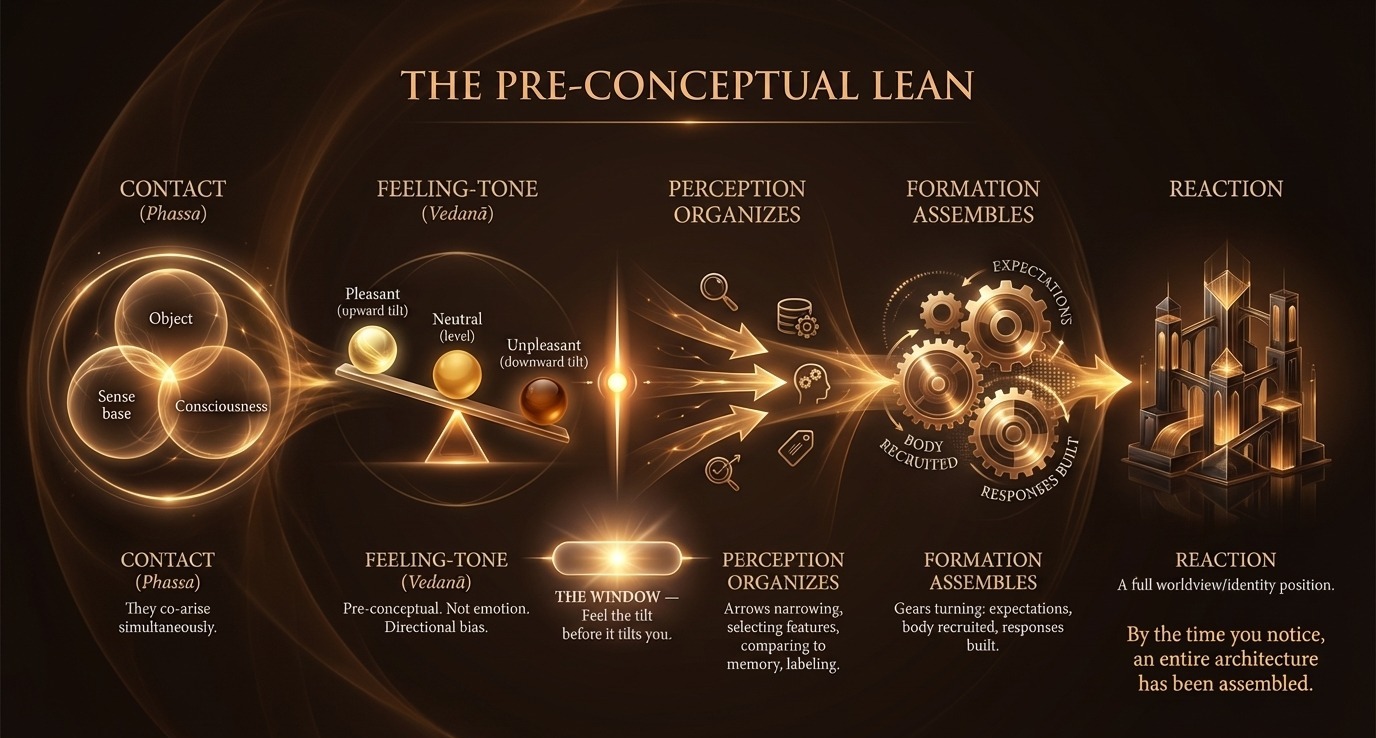
Attention begins moving toward what feels pleasant, away from what feels unpleasant. Neutral contact dissolves into the background, seemingly inconsequential. Perception starts organizing around the tilt — selecting features, comparing to memory, labeling. Formation assembles responses, builds expectations, recruits the body. And by the time you are aware that something is happening, an entire architecture of reaction has been quietly assembled from a single unseen lean.
How a Tilt Becomes a World
This is not a one-time event. It compounds.
Each moment of consciousness arrives already tinged by the previous tone. A direction is building — a momentum of seeing and expecting in a certain way. Preference thickens. Belief hardens. What you attend to, how you attend to it, and the way you participate in both become increasingly shaped by that initial bias. The horizon of what feels possible narrows. What was a momentary tilt becomes the curvature of an entire perceptual world.
If you carry the belief I am bad with conflict, then every slightly tense interaction gets read through that lens. Not because reality confirms it, but because the tone tilted unpleasant at the point of contact, perception highlighted threat, formation began bracing, and that preparation itself generated another unpleasant tone. The loop closes. The belief does not need to be true. It only needs the tilt to go unnoticed.
This is the first flicker of cyclic becoming. Feelings, perceptions, formations, consciousness — cycling again and again, each moment conditioning the next, each tilt recruiting the whole system to confirm what was never examined.
Intimacy Without Ownership
Every time tone appears, there is a subtle temptation to personalize it. Pleasant becomes for me. Unpleasant becomes against me. Neutral becomes irrelevant to me. The world does not change, but relation collapses into possession. Experience is no longer met — it is appropriated.
This appropriation is quiet. It does not announce itself. It simply converts contact into territory: mine, not mine, does not concern me. And from that conversion, the entire downstream architecture of selfing unfolds.
But there is another possibility at the point of contact. Not closeness without distance — closeness without ownership.
Intimacy, in this sense, is feeling the tone directly. Allowing its texture. Staying with its warmth or sharpness without seizing it, narrating it, or needing it to be different. The body's way of registering: I can feel this without becoming it. I can know this without controlling it.
When attention becomes receptive rather than grasping, when the system's natural friction becomes curiosity rather than defense, when intention softens into attunement rather than self-reference — the same moment of contact that would have launched the entire cascade simply breathes. The tilt is felt. It does not recruit.
What This Means for Practice
The discipline is not to stop the tilt. Vedanā arises with contact — it is not optional, and attempting to suppress it is just another form of appropriation. The discipline is to feel the tilt before it tilts you. To catch the lean at the point of contact, before attention narrows, before perception labels, before formation rushes forward dragging intention with it.
This is why stability matters — not as calm, not as stillness, but as the capacity of the field to remain coherent when tone appears. Stability is what allows you to stay with the birth of experience rather than being swept into its downstream consequences. Without it, the tilt recruits everything before you have a chance to feel what is actually here.
And this is where the training gets precise. You are not watching your thoughts. You are not managing your emotions. You are learning to feel the temperature of contact — the first coloring — before it becomes a world.
Reactivity does not begin with your reaction. It begins with a lean you never saw — and the whole life that formed around it.
Continue learning: Illumination 101
A 10-day course for practitioners who have the maps but haven't yet inhabited the territory.
Start the course →