The Architecture of Your Suffering
You believe suffering is something that happens to you. That it arrives from outside — caused by the difficult boss, the betraying partner, the body that will not cooperate, the mind that will not quiet down. Something goes wrong, and you suffer. Cause and effect. External event, internal pain.
This is a misreading of the architecture.
The Choreography
Every moment of experience is a choreography — you and the moment co-choreographing, neither one passive. You walk into a room carrying everything you have ever been: conditioning, preferences, unresolved histories, the accumulated momentum of becoming. The room brings its conditions. And in the meeting, a quality of experience is generated that belongs to neither side alone.
This is not metaphor. This is a description of the mechanism by which experience is structured, beneath the level of conscious reflection.
The Mechanism
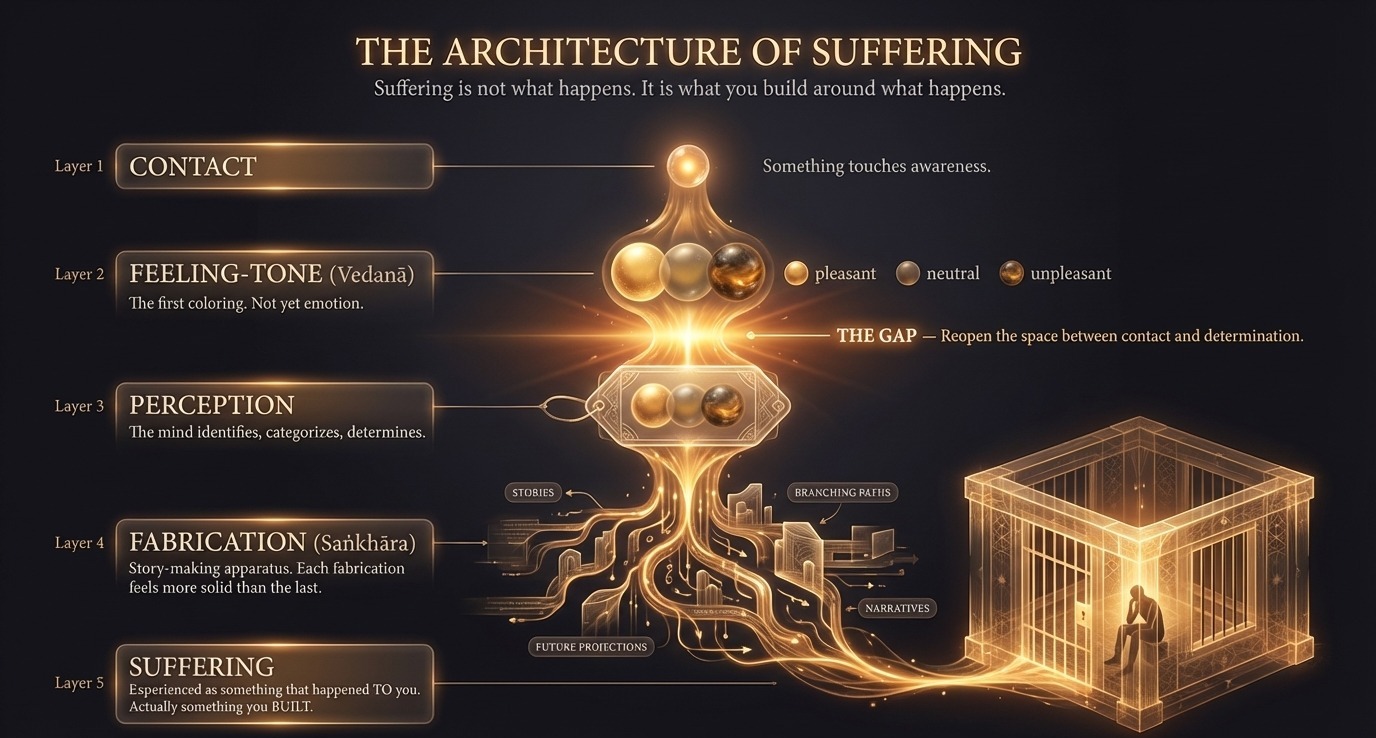
At the moment of contact with any experience — a sensation, a sound, a thought, another person — something happens before you have time to think about it. There is an immediate feeling-tone: vedanā. This is not emotion. It is simpler and more fundamental than emotion — the bare quality of pleasant, unpleasant, or neutral that colors every moment of contact. The first response of a sentient system to the fact of being touched by something.
You feel this right now. The quality of reading these words has a tone — something in the contact registers as agreeable or resistant, alive or flat. That registration is vedanā.
From this feeling-tone, perception arises — not passive reception but active determination. The mind identifies, labels, categorizes: this is a criticism, this is praise, this is danger. These perceptions are shaped by the feeling-tone that preceded them, which was shaped by the conditions you brought to the contact, which were shaped by everything that came before.
From perception, fabrication begins. Saṅkhāra — the volitional formations, the story-making apparatus of mind. The perceptions become a narrative: she is angry at me because she doesn't respect me, and this always happens, and I should have known better, and what does this mean about who I am? Each fabrication builds on the last, and each one feels more solid than the one before — until the whole construction has the weight of fact.
And the felt texture of living inside that construction — experiencing it not as something you built but as something imposed on you — that is suffering.
A Concrete Instance
You send a message to a friend. They do not reply. Contact: the fact of the unreplied message appearing in your awareness. Feeling-tone: a flicker of something unpleasant, barely registered. Perception: they are ignoring me. Fabrication: they must be upset about what I said last week. I knew I shouldn't have brought that up. They probably think I'm needy. This always happens — I get close to people and then I push them away.
Within seconds, you have constructed an entire architecture of meaning from a non-event. Your friend may be in the shower. You do not know. But the mechanism does not wait for data. It builds with whatever material is available, and it reaches first for the conditioning you brought to the moment.
The suffering you feel — the anxiety, the narrative of abandonment — was not caused by your friend's silence. It was generated by the mechanism that converts contact into feeling-tone, feeling-tone into perception, perception into fabrication, and fabrication into a lived world you experience as if it were simply what happened.
The Insistence at the Core
At every step of this chain, there is a moment of determination — and at every step, the option of insistence: hardening that determination into the only thing it could be.
Vedanā is not the problem. Contact generating a feeling-tone is the basic operation of sentience. But when "unpleasant" hardens into "this is bad," and "this is bad" hardens into "this should not be happening," and "this should not be happening" hardens into "something is wrong" — that cascade of insistence is where suffering is architecturally constructed.
You are not a victim of the cascade. You are its co-author — not deliberately, but through the conditioned reflex of determining, insisting, and then experiencing the results as if they were facts about the world.
This is what it means to say suffering is fabricated. Not that it is fake. But that the felt sense of being trapped is generated by a mechanism you are participating in, even though you cannot see the participation from inside the result.
The Misreading
Most approaches to suffering intervene at the level of the story — rewriting the narrative, challenging beliefs, replacing the negative thought with a positive one. This is not useless. But it leaves the architecture intact. You have replaced one fabrication with another. The next time contact generates an unpleasant feeling-tone, the whole machine fires up again.
The practice is not to fix the story. It is to see the mechanism in operation. To feel the feeling-tone without immediately determining what it means. To watch perception form without insisting it is the only perception possible. To recognize fabrication as fabrication — as the mind's constructive activity, not the revelation of how things are.
This requires the willingness to remain in the gap between contact and determination — a gap that has been closed so tightly the two seem simultaneous. The training is to reopen that gap, one moment at a time.
What Remains
When you catch the chain in motion — not just encountering its output but seeing the mechanism itself — the insistence loosens. The determinations still arise, but held with less rigidity. The stories still form, but you are no longer lost inside them.
What remains is not bliss. It is clarity — the capacity to feel what is actually here without needing it to be other than it is.
Suffering is not what happens. It is what you build around what happens — and the architecture is yours to see.
Continue learning: Illumination 101
A 10-day course for practitioners who have the maps but haven't yet inhabited the territory.
Start the course →