The Courage to See Your True Face
There is a moment in practice that nobody warns you about. Not the first opening. Not the dark night. Not the disorientation of seeing through self. This moment is quieter, more ordinary, more devastating: the realization that the thing you cannot see about yourself is the thing that matters most.
You have sat with anger. You have watched craving rise and dissolve. You have traced your patterns back to childhood and mapped the architecture of your reactivity with precision that would impress a clinician. And still -- something hides. Not because you lack technique. Because the eye that is looking is the eye that cannot see itself.
The Difference Between Looking and Seeing
There is a Zen koan that has survived a thousand years for a reason: What was your original face before your mother and father were born? It points directly at your unconditioned nature -- what you are before the layers of identity, preference, and performance. Not something to find. Something to recognize, because it was never absent.
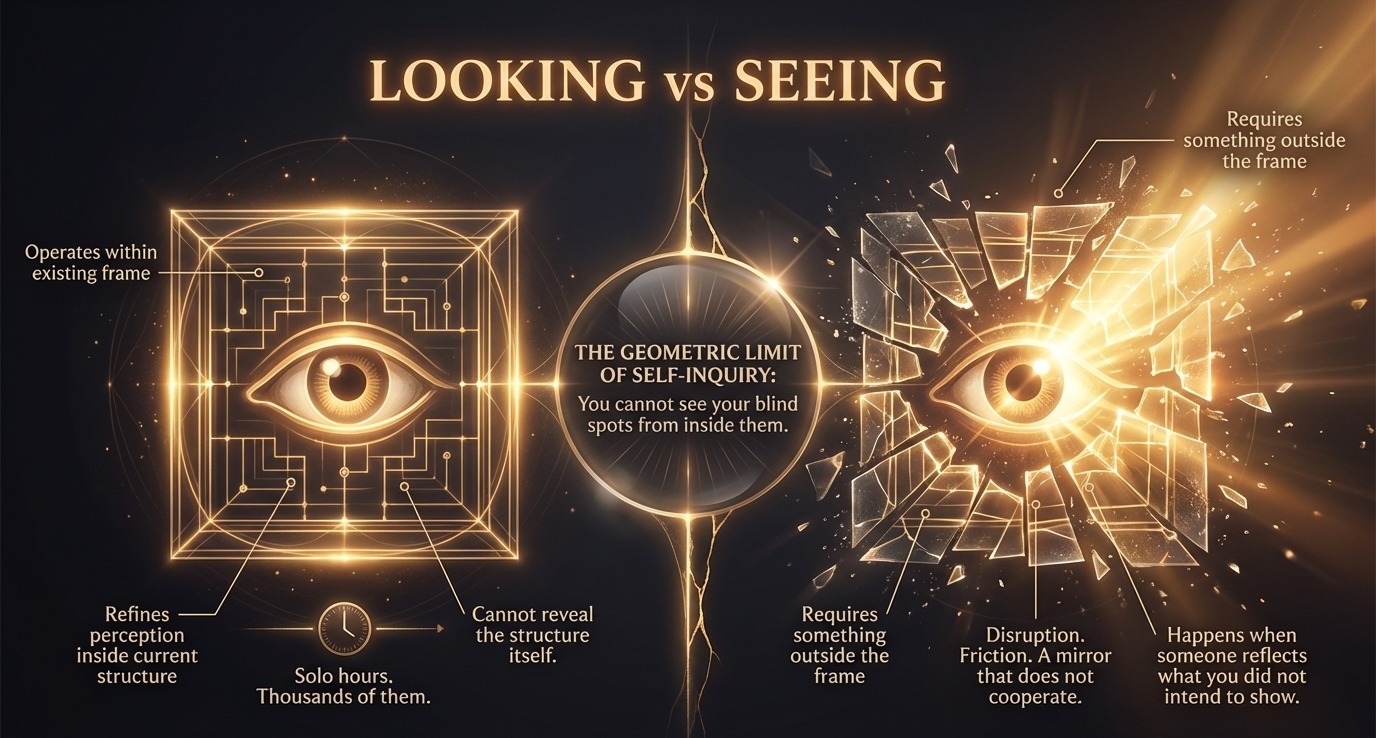
Looking is what you already know how to do. You sit, you observe, you note, you release. You have logged thousands of hours of this. And looking has brought genuine skill -- a nervous system that settles faster, an attention that can sustain contact with difficult material, an honesty about your own inner life that most people never develop.
But looking operates within the frame you already have. It refines perception inside existing structure. It cannot reveal the structure itself.
Seeing is different. Seeing requires something outside the frame -- a disruption, a friction, a mirror that does not cooperate with your self-image. Seeing happens when someone you trust says, "That is not what I observe in you," and the ground shifts. When you are mid-sentence, certain of your clarity, and a face across the room reflects something you did not intend to show.
Looking refines what you already know. Seeing breaks the frame that looking cannot find.
What Hides in Plain Sight
Here is what years of solo practice produce: an exquisitely detailed map of the territory you are willing to explore. The edges of that map -- the places where you flinch, contract, or quietly exit -- remain invisible precisely because you are the one drawing.
Consider what happens when strong feeling arrives. The swell of grief in your chest and the immediate reflex to clench -- to straighten your spine, to bite the inside of your cheek, to do something, anything, to keep from being that exposed. Not because you lack courage in the abstract. Because somewhere -- maybe age seven, maybe thirteen, maybe in a moment so early it has no narrative -- you learned that being seen in that rawness was dangerous. Someone said don't cry. Someone looked away. Someone made it clear that your unguarded face was not welcome.
That learning does not dissolve on the cushion. It lives in the body as architecture. It shapes what you allow yourself to feel in the presence of others, which means it shapes what you allow yourself to feel at all. The deepest feelings are not private events. They are relational. They need a witness to complete themselves -- not for validation, but for reality.
Grief that has never been seen by another person remains, in some fundamental sense, unfelt.
You can spend a decade doing the interior work and still be holding back the one thing that would change everything: the willingness to be seen exactly as you are. Not the meditator. Not the one who has it together. The one who is shaking.
Why You Cannot Do This Alone
Self-inquiry has a structural limit, and it is not about effort or sincerity. It is about geometry. You cannot see your own blind spots from inside them.
The places where you most need to see clearly are the places where your seeing is most distorted. Your defenses are not crude -- they are elegant, intelligent, woven into the fabric of your perception so seamlessly that they feel like reality. The way you subtly perform composure when you are falling apart. The way you frame vulnerability as something you have already worked through. The way you can describe your patterns with such fluency that the description becomes another layer of protection.
A human mirror -- a practitioner who knows your patterns, a teacher who has watched you flinch, a group that has seen you at your most defended and your most open -- catches what you edit out.
The face you show yourself is always curated. The face others see is closer to what is actually there.
The Courage That Practice Actually Requires
The courage that matters here has nothing to do with sitting through pain or tolerating difficult states. It is the courage to let someone else hold the mirror. To stay in the room when you want to leave. To let the tears come when every nerve is firing not here, not in front of them. To say the thing you have never said -- not because confession is therapeutic, but because the unsaid thing is the wall between you and the next depth of your own experience.
This is not weakness. This is the advanced practice that no amount of solo hours can replace.
When a group of practitioners commits to this kind of honesty -- not the polished sharing of insights, but the raw, stammering, contradictory truth of what is actually happening -- something becomes possible that was not possible alone. The container holds what the individual cannot. The field metabolizes what the private mind recycles. You say the thing you were afraid to say, and behind the fear is just the open, aching, ordinary fact of being human with other humans.
The Question Behind the Question
The koan points to what you are before all fabrication -- your unconditioned nature, always already present. But most practitioners discover something uncomfortable: recognizing that nature requires letting the performed face fall. And letting it fall, truly, requires witnesses. Not because the truth needs validation. Because the habit of performance is so deeply woven into your perception that you cannot catch it operating without someone outside the system.
Your true face is not hidden. It is the one you keep turning away from -- not because it is terrible, but because it is tender. Undefended. Unfinished.
It can only be seen in the presence of others willing to be seen the same way.
The face you have been looking for is the one you have been afraid to show.
Continue learning: Illumination 101
A 10-day course for practitioners who have the maps but haven't yet inhabited the territory.
Start the course →