
The Heroic Cycle: Why Your Breakthroughs Keep Crashing
You know this pattern. A surge of clarity arrives -- on retreat, in a late-night sit, after a week of renewed commitment -- and suddenly everything feels possible. The fog lifts. You can see the architecture of your own reactivity with startling precision. You double your sit time. You recommit. You tell yourself that this time, something has genuinely shifted.
Then, three days later, you are scrolling your phone in bed, skipping practice, and narrating the memory of the opening instead of returning to it. The crash is total. And from inside the wreckage, the only move you know is to muster enough urgency to spike again.
This is the heroic cycle. And it is not a discipline failure. It is a pattern with its own logic, its own seduction, and its own cost.
The Achievement Trap in Practice
The heroic cycle runs on a specific engine: the conflation of intensity with progress. It is the same architecture that drives the all-nighter before a deadline, the Hail Mary workout after weeks of inactivity, the grand gesture that substitutes for sustained presence. You manufacture urgency so you can experience yourself overcoming it.
The spike feels like practice. It has the texture of effort, the appearance of commitment. But the spike is the nervous system in overdrive -- grasping, clenching, performing -- not the nervous system building the wiring to hold what genuine contact demands.
What makes this pattern so difficult to see is that it produces real results. You do have openings during the surge. You do touch something genuine. The breakthroughs are not fake. But they cannot be held, because the container that would hold them was never built. You are running high-voltage realization through wiring designed for short bursts, not sustained current.
Intensity without capacity is just a more sophisticated form of avoidance.
The Hidden Payoff
The crash serves a function. It reinstates the familiar sense of insufficiency -- the feeling that you are broken, behind, not yet there. And that feeling is the fuel for the next spike. Without a crisis to overcome, you might have to sit with the terrifying ordinariness of a life that simply works.
The heroic cycle is a closed loop. Crisis generates urgency. Urgency generates a spike. The spike generates exhaustion. Exhaustion generates a crash. The crash generates a new crisis. At no point does the system encounter what it is actually avoiding: the slow, unimpressive, ego-deflating work of building a baseline that does not require heroics to sustain.
This is why simplicity feels threatening. If you have spent years investing in the narrative of the spiritual warrior conquering inner demons, then chop wood, carry water is not a relief. It is an identity crisis. Because if you are not the hero overcoming the obstacle, who are you?
That question, met honestly, is where the real practice begins.
Realization Fitness: The Training Model That Holds
In physical training, this has a name: overreaching without recovery. The athlete who trains at max effort every session, skipping deload weeks, ignoring progressive overload. They plateau, injure, quit. The body does not adapt to what it cannot survive. It adapts to what it can repeat.
The same principle governs contemplative training. Realization fitness is the capacity to sustain genuine contact with reality -- not in peak moments, but as a baseline. And baselines are built the way all endurance is built: through volume at manageable intensity, compounded over time.
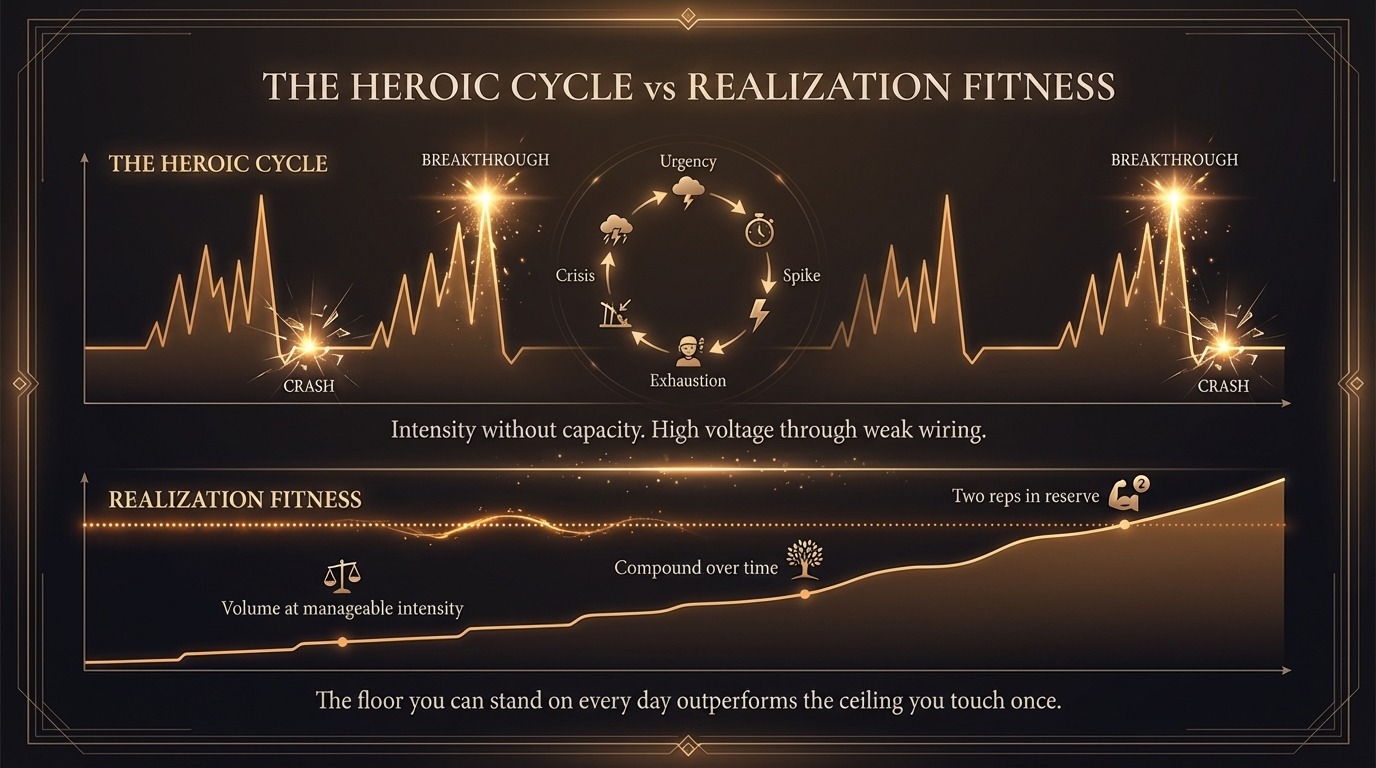
Two reps in reserve. Zone two training. Twenty minutes daily instead of ninety minutes twice a week. The instruction sounds almost insultingly simple. But simplicity is the point. The heroic cycle mistakes the ceiling for the training. Realization fitness trains the floor.
This means sitting when it feels like nothing is happening. Staying with the practice when no breakthrough is on the horizon. Allowing the nervous system to learn what grounded actually feels like -- not as a concept, but as a somatic reality that the body can return to without effort.
The floor you can stand on every day will always outperform the ceiling you touch once and fall from.
What Pacing Actually Asks Of You
Pacing is not moderation. It is the discipline of refusing to let intensity substitute for consistency. It asks you to build while feeling inadequate, to practice while nothing impressive is occurring, to tolerate the withdrawal symptoms of a nervous system accustomed to the dopamine of crisis and resolution.
This is where the flinch shows up -- not as resistance to difficulty, but as resistance to ordinariness. The practitioner caught in the heroic cycle will feel, viscerally, that steady practice is not enough. That something more dramatic is required. That feeling is the pattern defending itself.
The shift is from force to form. From motivation driven by rescue -- rescuing yourself, rescuing your practice, rescuing your life from the mess you unconsciously created -- to motivation driven by embodiment. Showing up not because you are in crisis, but because this is what a life of practice actually looks like.
What compounds is not the peak. It is the willingness to return.
Continue learning: Illumination 101
A 10-day course for practitioners who have the maps but haven't yet inhabited the territory.
Start the course →