The Performance of Practice
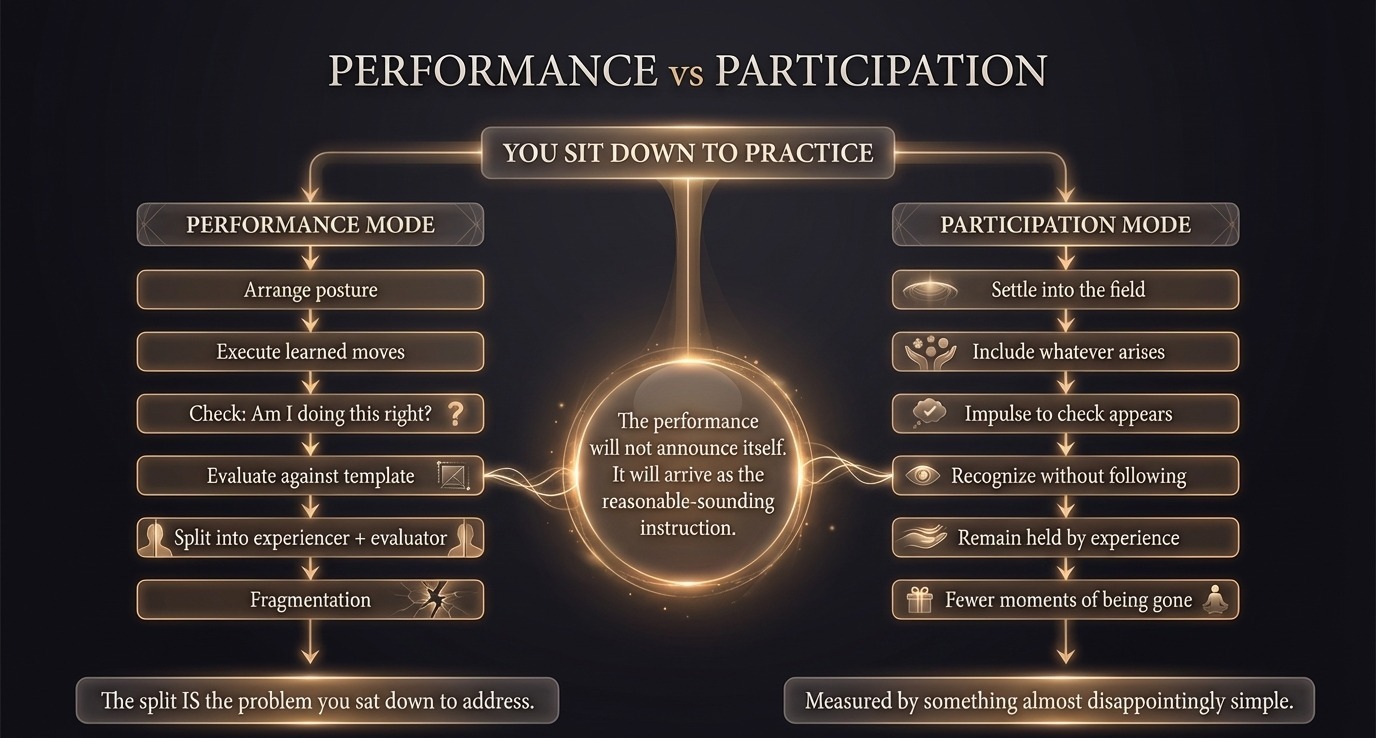
You sit down. You arrange the posture. You close your eyes at the right moment, settle into the breath at the right pace, and begin doing the thing you have learned meditation is. Within minutes, you are running a program — executing a set of moves you have absorbed from teachers, books, retreat instructions, and the accumulated aesthetic of what a meditator does.
This is not practice. This is performance.
The Template Trap
Consider couples therapy. A therapist gives you and your partner conversational tools: pause before reacting, use "I" statements, don't make accusations, reflect back what you heard. These are useful scaffolds. They stabilize a volatile dynamic long enough for something real to emerge.
But the scaffold is not the thing. If you cling to the template — if "patience" means only letting your partner speak for twenty minutes without interrupting — you have mistaken the representation for the quality it was meant to cultivate. What if, halfway through that twenty minutes, something fundamental gets buried under the accumulation of content? What if the patient thing, the actually intimate thing, would have been to briefly interrupt at the right moment?
Only you can know what patience looks like when you are genuinely embodying it rather than performing its appearance.
Meditation works the same way. You have been given templates — watch the breath, note sensations, cultivate equanimity. And you have assembled from these templates a representation of what a good sit looks like. Calm mind. Focused attention. A particular quality of stillness. You then spend your sessions trying to align yourself with that image.
The image is not the practice. The alignment is the performance.
"Am I Doing This Right?"
This question is the signature of performance. It reveals that you are measuring your actual experience against a representation of what experience should be. You are standing outside your practice, evaluating it, comparing this sit to last sit, checking whether the quality of your attention meets some internalized standard.
Every time you perform that check, you interrupt the continuity of the moment. You split experience into two: the one having it and the one evaluating it. And that split — that stepping outside to assess — is itself the very fragmentation you sat down to address.
The checking is not incidental. It is structurally identical to the way you operate in daily life. You monitor your performance at work, in relationships, in how you present yourself. You have internalized an image of who you should be and spend enormous energy maintaining alignment with it. Practice was supposed to be the place where that pattern dissolves. Instead, you have imported it wholesale onto the cushion.
Insistence Dressed as Discipline
What drives the performance is insistence — the subtle demand that experience conform to what you have decided it should be. You have an idea of what stability looks like (calm, quiet, focused), and you try to force your experience into that mold. When thoughts arise, you push them away — not because presence demands it, but because your representation of presence doesn't include thinking. When restlessness shows up, you clamp down — not because settling is what the moment requires, but because restlessness doesn't match the image.
Even "deeper" practitioners fall into this. You touch genuine absorption and immediately begin trying to reproduce it. You associate a particular quality — warmth, spaciousness, a sense of non-separation — with progress, and now every sit becomes an attempt to instantiate that state. But the moment you try to instantiate it, you have converted a natural quality of experience into a target. And a target requires aiming. And aiming requires a you standing apart from the experience, directing it.
That is performance, regardless of how subtle it becomes.
What Practice Actually Looks Like
Stability — the kind worth cultivating — is not a stable pleasantness or a stable absence of unpleasantness. It is the capacity to meet the entire field without narrowing onto any part of it. Including the parts that want to check, fix, manage, and perform.
When the impulse to evaluate arises — am I concentrated enough, is this deep enough, have I been distracted too long — the practice is not to suppress the impulse. It is to include it. To recognize the check without following it. To let attention remain held by experience rather than directed at experience.
This means a successful session has nothing to do with more bliss or less thought. The pendulum will swing — restlessness, stillness, boredom, intensity. These oscillations are not obstacles to practice. They are the field within which practice happens. The training is not to flatten the swings but to remain present through them. To have the presence of mind, amid whatever is arising, to simply recognize what is occurring without abandoning the whole for any part.
A successful session, at this stage, is measured by something almost disappointingly simple: fewer moments of unconsciously abandoning the entirety of the field. Not zero moments. Not a pristine unbroken awareness. Just — fewer moments of being gone without knowing you were gone.
The Subtlety
The performance will not announce itself. It will not arrive as an obvious forcing. It will arrive as the reasonable-sounding instruction to return to the breath. As the earnest desire to deepen concentration. As the felt sense that you are finally doing this right.
Notice that feeling. That is the template reasserting itself.
The training is not to never use techniques, anchors, or instructions. These provide scaffolding — something to return to when the system overwhelms. But the scaffolding serves a function only when you remember that the point is not the scaffolding. The point is the intimacy with experience that the scaffolding was meant to stabilize.
When you catch yourself performing — and you will, again and again — do not make that into another failure. Include it. And rest.
Continue learning: Illumination 101
A 10-day course for practitioners who have the maps but haven't yet inhabited the territory.
Start the course →