The Solo Meditator Paradox
You have been practicing for years. You can sit for an hour without fidgeting. You have read the maps -- Theravada, Mahayana, maybe some Vajrayana, maybe some nondual pointing-out instructions from YouTube. You have had genuine openings. You know what equanimity feels like from the inside. You regulate your nervous system better than most therapists. And somewhere in the last year or two, you noticed that nothing is really moving anymore.
You are not a beginner. You are not lost. You are a solo practitioner who has hit a ceiling -- and the qualities that brought you here are the exact ones keeping you pinned.
The Freedom That Becomes the Cage
Solo practice selects for a particular kind of person. Self-driven, discerning, allergic to dogma. You left -- or never entered -- traditions that demanded conformity. You built your own synthesis from what was available. You sat through resistance on your own terms, made your own discoveries, and developed a confidence that comes from figuring things out without anyone holding your hand.
This is not a small thing. Most people never develop the sovereignty to practice independently. You did. And that sovereignty became the architecture of your entire path.
The problem is that architecture has a ceiling.
Three Gears, One Loop
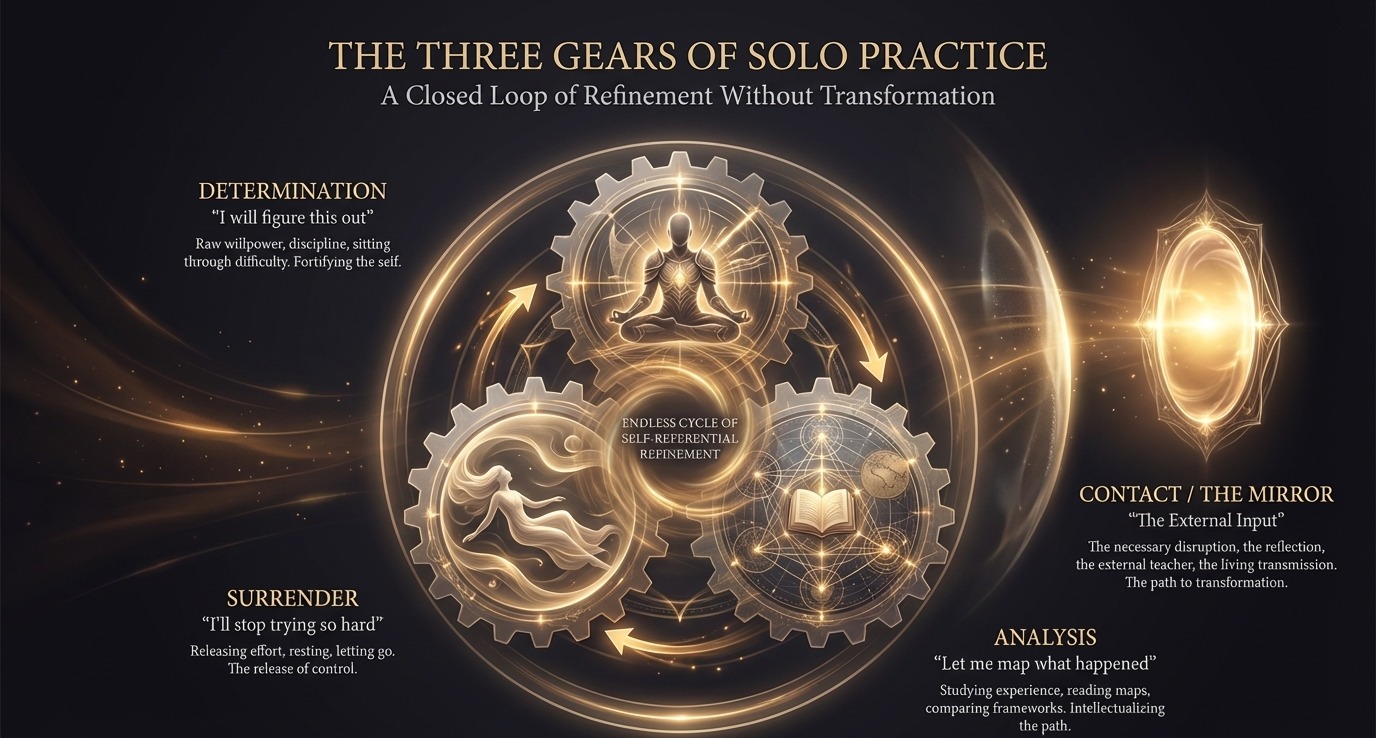
Watch what happens over time. Solo practitioners tend to develop three capacities -- and then cycle between them indefinitely.
Strong determination. You learned to sit through resistance. You built the ability to sustain attention, enter absorptions, bend experience toward stability. This carried you far. But determination without relational feedback hardens into rigidity. You insist reality conform to your vision -- while simultaneously trying to see beyond that vision.
Critical analysis. You turned the lens inward. Self-inquiry, metacognition, expanding awareness. You got good at deconstructing concepts, watching thought-structures assemble and dissolve. But analysis without contact drifts into hovering -- a disembodied observation of your own life. You can describe your triggers with clinical precision while never actually feeling where they live. You mistake dissociation for equanimity. You become more interested in analyzing an argument with your partner than in actually connecting with them.
Surrender. Exhausted by effort and analysis, you learned to release control. To let go of agency and trust what unfolds. This felt like the breakthrough -- the gear beyond gears. But surrender without accountability becomes passivity. You wait for flow. When flow does not arrive, you cannot act. Fading, unresponsive, calling it peace.
Each switch feels like a genuine breakthrough. Determination to analysis feels like waking up. Analysis to surrender feels like letting go. Surrender back to determination feels like re-engaging. The loop can run for a decade. And because each transition produces a temporary opening, you never see the loop itself.
The very qualities that brought you to awakening become the architecture that prevents the next one.
The Missing Mirror
Here is the structural issue. Each capacity can only be refined from outside the capacity itself. Rigidity cannot see its own rigidity. Hovering cannot feel its own distance. Passivity cannot diagnose its own absence. You need something that talks back.
Eyes cannot see themselves.
This is not a metaphor for weakness. It is a description of how self-referential systems work. Without an external mirror -- a teacher, a co-practitioner, a container that introduces genuine friction -- your practice optimizes within its current structure. You get more articulate about your patterns. You develop better vocabulary for the loop. But the loop does not break.
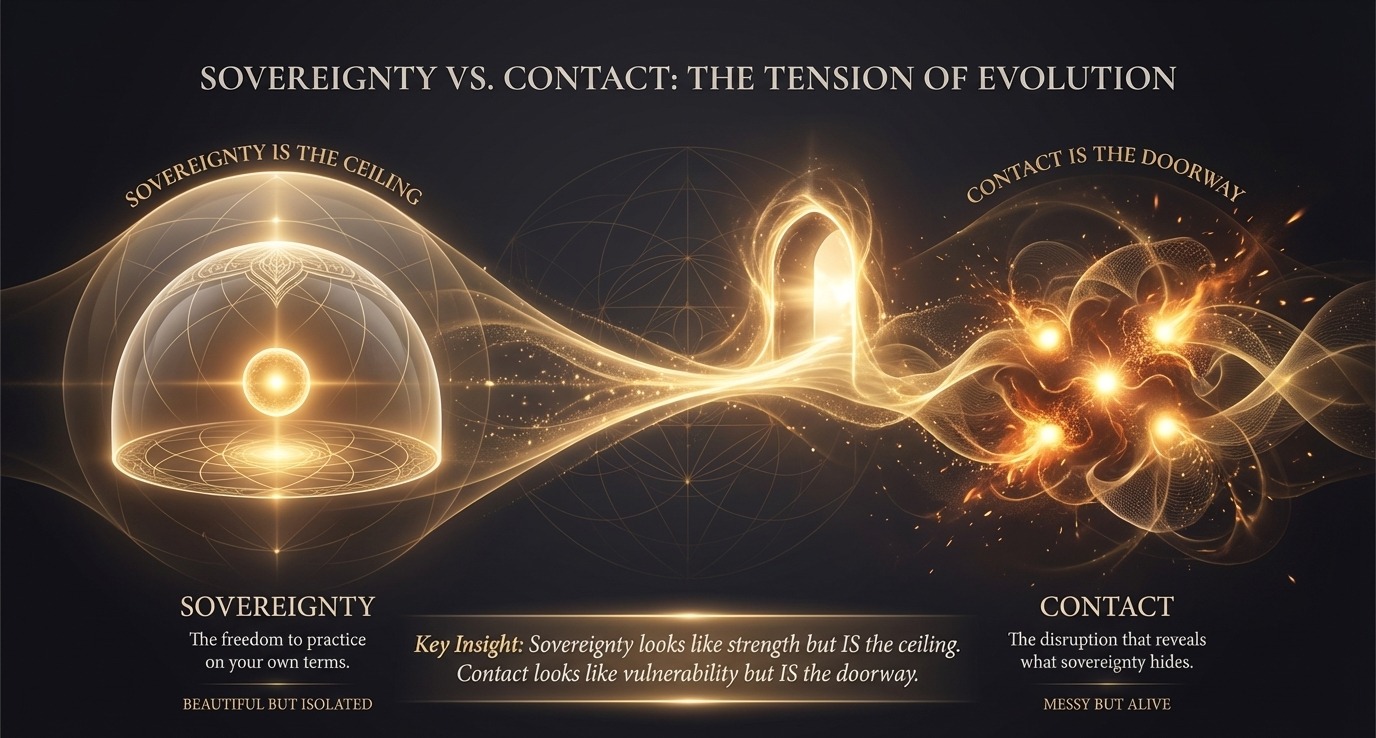
The literal definition of a blind spot is that when someone points it out, you will not be able to see it. You have to trust their perception of you more than your own. And trusting someone else's perception of you is the one thing a solo practitioner has been structurally trained to avoid.
The Liminal Position
So you arrive at a specific impasse. Pleasant states have hit diminishing returns. The cycles of opening and regression are starting to look identical. You have had the same "final breakthrough" three times. You are too awake to go back to ordinary life as if none of this happened, and too isolated to move forward.
The question is not whether you need more practice. It is whether you need a different kind of friction.
Not another technique. Not another retreat indistinguishable from the last ten. Not another awakening cycle where you switch from surrender back to determination and call it progress. What you need is a living container -- something that pushes back, that sees what you cannot, that makes your practice consequential in real time.
This means letting yourself be seen. Not as the advanced practitioner with sophisticated maps. Not as the sovereign agent who has it figured out. Seen in the place where you flinch -- the place where the pattern reasserts itself and you are, for a moment, genuinely blind.
The Choice Point
There is a question worth sitting with: has your independence become indistinguishable from avoidance?
Not avoidance of difficulty -- you have proven you can sit with difficulty. Avoidance of being known. Of putting yourself in a position where someone you trust can say, "I don't believe it," and you feel the sting. Where someone can point at a blind spot and you cannot immediately explain it away.
The flinch around this is worth studying. If the idea of being genuinely measured by someone -- not evaluated, not judged, but seen with precision by someone whose perception you respect -- produces anxiety, that anxiety is not a sign of weakness. It is the edge of your current container. It is exactly where the next phase of practice lives.
You can continue refining what you have. The plateau is real and it is comfortable. But if you have watched enough cycles to know that the next one will look like the last, then the path forward requires what you have been avoiding: not the loss of sovereignty, but the willingness to let sovereignty be tested by contact.
The structure built to protect the path becomes the last thing the path needs you to release.
Continue learning: Illumination 101
A 10-day course for practitioners who have the maps but haven't yet inhabited the territory.
Start the course →