The Stability You Are Building Will Never Hold
You have spent years building a life that holds together. A coherent identity, a set of beliefs that make sense, a way of orienting that keeps the ground beneath your feet from shifting. You know who you are at work, who you are in your relationships, how you show up in your practice. And all of this — every piece of it — depends on conditions remaining the way you have arranged them.
This is the stability you know. It is conditional. And it will never hold.
Two Kinds of Stability
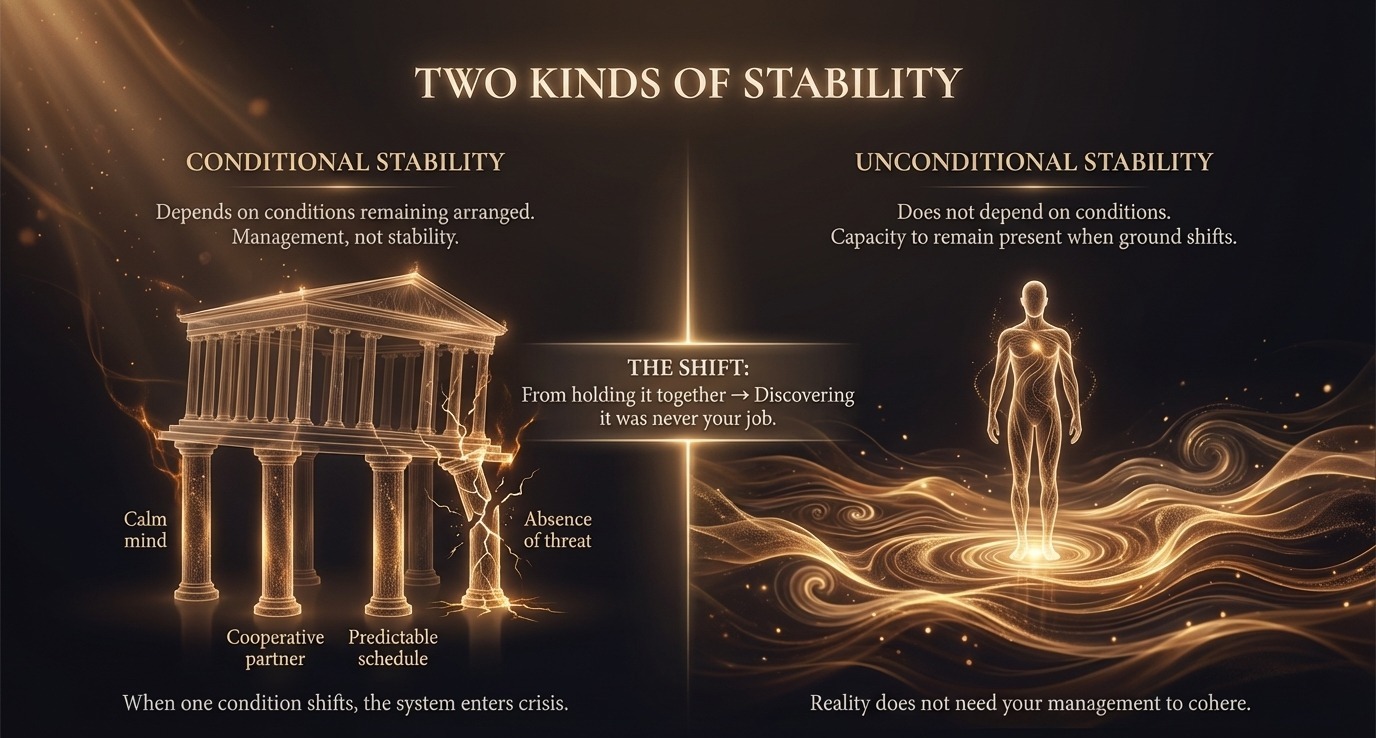
There is a stability that depends on things being a particular way. Calm mind, cooperative partner, predictable schedule, absence of threat. When these conditions hold, you feel grounded. When they shift, you scramble to reorganize — to reassert the configuration that gave you your footing.
This is not stability. It is management.
Then there is a stability that does not depend on any particular condition. Not indifference to conditions — not the pretense that nothing matters — but the capacity to remain present when the ground shifts. To participate in uncertainty without collapsing into reaction.
The first kind is what you have been building your entire life. The second kind is what practice is actually training.
The Architecture of Conditional Stability
Conditional stability works through insistence. You decide what things are — this is a good relationship, this is a threatening situation, this is who I am — and then you defend those determinations against any evidence that would destabilize them. Your attention moves from reference point to reference point, validating the structure, patching the cracks, redirecting away from whatever doesn't fit.
When something threatens the structure — a piece of feedback that contradicts your self-image, a partner who sees through the role you are performing, a moment on the cushion where the familiar ground drops away — the system goes into crisis. You freeze, or you fight, or you scramble to reassemble the narrative.
Think of being caught in a small lie. Not even a significant one — a little white lie told to maintain coherence, to keep the image intact. When you are caught, the response is wildly disproportionate to the stakes. Panic. Confusion. The feeling that the world is falling apart. That response has nothing to do with the lie itself. It has to do with the momentary collapse of the entire management structure. For a few seconds, you do not know where you stand. And that feeling — that groundlessness — is what the entire architecture of conditional stability was built to prevent.
What Stability Is Actually Asking
The practice is not to build a better management structure. It is to discover that experience does not need your management to cohere.
This is not a belief to adopt. It is something you demonstrate to yourself, rep by rep, through the willingness to rest the insistence and see what happens. When you stop forcing the moment to be what you have decided it is — when you allow it to be pleasant, unpleasant, both, neither — something does not fall apart. Something coheres. Not in the shape you would have chosen. But it coheres.
This is the structural insight: reality does not need you to hold it together. It was never your job. The holding was the problem.
When you understand this on the cushion — not as a concept but as a lived recognition — you begin to see its implications everywhere. The stability you sought in your relationships was not stability but control. The ground you stood on in your identity was not ground but insistence. The certainty you craved in your worldview was not clarity but rigidity.
And all of it was exhausting. Because maintaining conditional stability against a reality that is fundamentally fluid requires constant energy. You were holding your breath underwater and calling it breathing.
Trust as a Choice
This is where trust enters — not as a feeling but as a decision. You cannot wait until you feel safe to trust. Safety, in the way you have been pursuing it, is conditional stability by another name. Trust means stepping into the territory where the conditions have not been arranged, where the outcome is not guaranteed, where the familiar ground is absent — and choosing to remain.
You have been making trust conditional the same way you have been making stability conditional. I trust this, but not that. I trust myself here, but not there. You compartmentalize trust the way you compartmentalize identity, parceling it out to the zones that feel managed. But trust that depends on conditions is not trust. It is calculation.
The trust that practice cultivates is something else entirely. It is the recognition — earned through repetition, not argument — that you can participate in what is uncertain without needing to resolve the uncertainty first. That you can remain in the heat, the friction, the not-knowing, and not reach for the exit.
This is a skill. It is built the way any skill is built: through deliberate engagement with exactly the territory you have been avoiding. Not once, but again and again, until the reconditioning takes hold.
The Courage Beneath Trust
Trust requires courage because it means stepping out of the known. And the known, however exhausting, is at least familiar. You know how to manage. You know the moves. Unconditional stability asks you to set those moves down — which means discovering, first, that you do not know what happens next.
This is the fear: that if you stop insisting, it will all fall apart.
The fear is accurate in one respect. Something does fall apart. But what falls apart is the management structure, not reality. And what remains, once the performance of holding it together drops, is not chaos. It is a coherence that was there all along — one that did not need your insistence, only your willingness to stop obscuring it.
Stability is not the absence of movement. It is the capacity to remain — present, accountable, and undefended — while everything moves.
Continue learning: Illumination 101
A 10-day course for practitioners who have the maps but haven't yet inhabited the territory.
Start the course →