
The Three Exits That Keep You Stuck
If you have been practicing for more than a few years, you have probably arrived at a quiet suspicion that something is not working. Not that meditation is fake, or that the traditions are wrong, but that the way you are engaging with it has produced a very specific kind of exhaustion. You are not a beginner. You are something harder to help: an experienced practitioner who has run out of moves.
Here is the architecture of that exhaustion. There are three exits available to you, and all three are locked.
Exit A: More Effort
Try harder. Add another technique. Find the right teacher this time. Increase the sit length. Sign up for one more retreat. This is the most popular exit, and the most insidious, because it looks exactly like commitment.
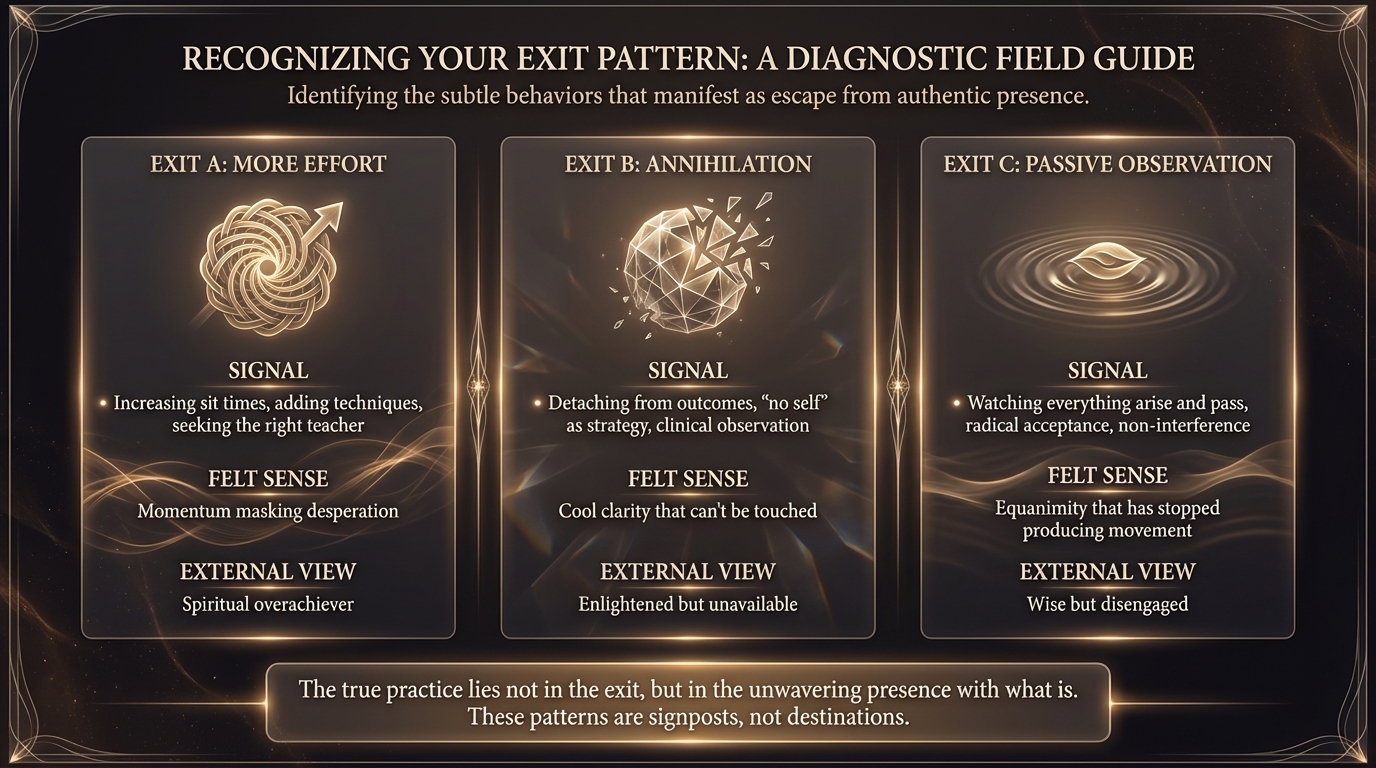
Exit A produces temporary momentum and chronic burnout. The practitioner becomes a spiritual overachiever -- someone whose practice is functionally indistinguishable from their professional compulsions. The cushion becomes a second workplace: another arena of performance, another opportunity to fall short.
You will know you are living in Exit A if your practice has a quality of driven urgency to it, if you evaluate sessions as "good" or "bad," if you are quietly hoping that the next technique, the next teacher, the next retreat will be the one that finally works.
Exit B: Annihilation
Destroy the self that is doing all the trying. If there is no one home, there is no one to fail. This exit borrows the language of non-duality -- no self, no doer, nothing to attain -- and uses it as a sophisticated form of dissociation.
Exit B produces a particular kind of practitioner: someone who can discourse eloquently about the emptiness of the self while remaining fundamentally disconnected from their own embodied experience. It is flinching disguised as transcendence. The practitioner has not dissolved the self; they have simply evacuated the body and moved into their concepts.
You will know you are living in Exit B if you find yourself observing your thoughts and emotions with a clinical detachment that never quite makes contact, if you can describe your inner life with impressive precision but have not actually felt anything in months.
Exit C: Passive Observation
Do nothing. Watch it all arise and pass. Let go. Accept. Surrender. This seems like wisdom, and sometimes it is. But more often it produces what might be called Castrated Agency: a practitioner who has disabled their capacity for genuine engagement in the name of non-interference.
Exit C is seductive because it requires nothing. No effort, no confrontation, no risk. The practitioner becomes a spectator of their own inner life -- present in a technical sense, but never actually participating. Difficulty is tolerated rather than met. The practice has the surface of equanimity and the substance of avoidance.
You will know you are living in Exit C if your default response to difficulty is a vague "it's all arising and passing," if you have confused passivity with acceptance, if your practice has a quality of going through the motions without any real contact.
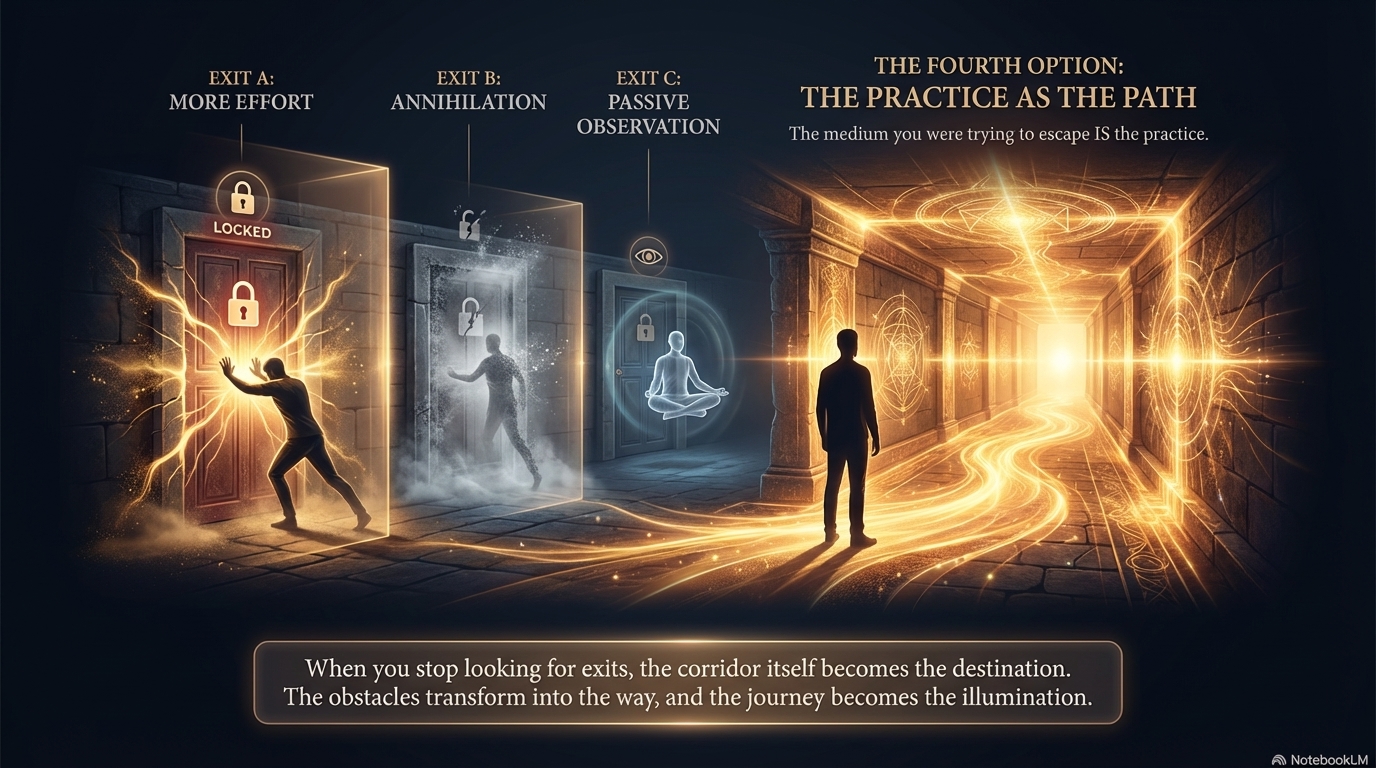
The Fourth Option
The Fourth Option is not a fourth door in the same corridor. It is a reorientation to the corridor itself.
Here it is, stated plainly: suffering is not the problem to be solved before practice can begin. It is the very medium through which practice occurs. The signal -- the discomfort, the restlessness, the nagging sense that something is off -- is not evidence that something has gone wrong. It is evidence that the practice is reaching you.
This is a fundamentally different orientation. You are not trying to escape the room. You are learning to live in it. Not with resignation, but with the active, interested presence of someone who has decided to stop rearranging the furniture and start actually inhabiting the house.
The difference between a meditator and a practitioner is not that one has stopped suffering. It is that one has stopped treating suffering as evidence of failure.
Most practitioners spend years rotating between the three exits -- trying harder, then transcending, then passively observing, then trying harder again -- without ever noticing that the rotation itself is the trap. The Fourth Option begins the moment you stop reaching for exits and start asking a different question entirely: what is actually here, right now, if I stop trying to make it different?
That question does not require a new technique. It requires a willingness to stay.
Continue learning: Illumination 101
A 10-day course for practitioners who have the maps but haven't yet inhabited the territory.
Start the course →