How You Kill Insight Before It Lands
You have had genuine insight. Something cracked open — the structure of a belief, the mechanics of a pattern, the quiet architecture of a suffering you had been living inside for years. For a moment, you saw clearly. The seeing was bodily, immediate, undeniable.
And then it evaporated.
Not slowly, not over days. In the moment itself, something moved — a reflex, a flinch — and the insight lost its heat. You were left with the memory of having seen something, but the seeing itself was gone. You could describe it, but you could no longer stand inside it.
This is not a failure of the insight. It is a failure of containment. The system could not tolerate what the fire was revealing, and it reached for an exit before the burn could complete.
The Anatomy of a Dirty Burn
Fire appears when two structures are held in sustained friction without release. Two narratives that cannot both be true. A way reality is and the way reality must be — held together until the grasping in the moment begins to destabilize.
What burns is not experience. What burns is the way experience is being held — structured, frozen, appropriated.
But the quality of the burn depends on the quality of the fuel. When the fuel is pure — when the system can remain present with what is being revealed — the burn is clean. Light without obscuration. When the fuel contains impurities — the structures the appropriating mind has bent to preserve identity — the burn is dirty. Smoke, obscured vision. Eventually the fire suffocates itself.
Those impurities have names. They are three reflexes so ordinary you have probably enacted all of them today.
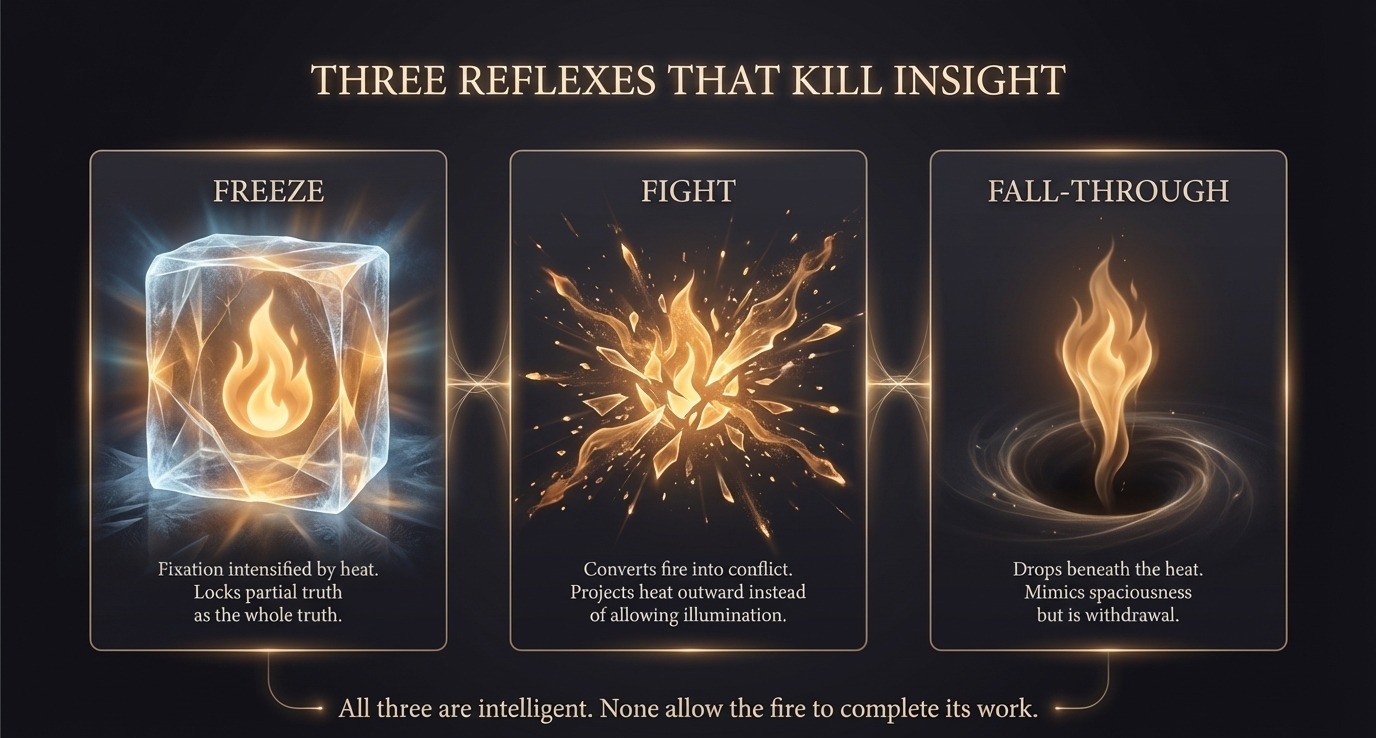
Freeze
When the heat becomes intolerable, the first reflex is to stop all movement. The mind tightens around a single interpretation — a stance, a conclusion, a declaration of certainty. This must be the answer. I know what this is.
Freeze is fixation intensified by heat. Attention narrows. Ambiguity becomes threatening. The system is not seeking truth — it is seeking immobility.
The insight was threatening the ground the self was standing on, so the self froze the ground. Whatever partial truth was available gets locked in as the whole truth. What was being revealed — the constructedness of the meaning structure — is papered over by a new certainty that feels like clarity but functions as armor.
Fight
When the system cannot lock meaning down, it often shifts to discharge. Fight is the attempt to push the tension outward — as argument, justification, explanation, persuasion, or the quiet hum of subtle superiority.
Internally, this looks like rehearsing arguments, mentally proving yourself right, narrating why the other side does not understand. Externally, it appears as contention that creates the illusion of agency. Something is being done. But clarity does not increase. Smoke increases.
Fight converts fire into conflict. Instead of allowing heat to illuminate internal architecture, the system projects it outward. Meaning becomes defended rather than examined, and the paradox that was doing the real work is replaced by a debate that accomplishes nothing.
Fall-Through
If neither freezing nor fighting restores coherence, the system may abandon the field entirely. Nothing matters. This is pointless. Why bother.
Fall-through can masquerade as spaciousness, even as emptiness. But internally it is withdrawal. The system has not opened — it has dropped beneath the heat. Care is numbed, significance is flattened.
Because the underlying structure was never clarified, the same pattern will reignite later, often with greater volatility. The material is still there, unburned.
Fall-through is the most dangerous of the three because it looks the most like progress. But equanimity is the capacity to remain present with the full weight of what is arising. Fall-through is the refusal to remain present at all.
The Intelligence of the Reflex
These three strategies are not mistakes. They are conditioned responses developed in the presence of genuine threat — each one trying to preserve continuity when the system feels it cannot afford to be open.
Freeze preserves continuity by arresting movement. Fight preserves it by forcing alignment. Fall-through preserves it by disengaging significance. All three are intelligent. None of them allow the fire to complete its work. They manage the heat but do not clarify the structure.
What a Clean Burn Requires
What is being trained is not a new response. It is the absence of premature response.
Staying with the heat, the uncertainty, the unresolved tension. Not as passive endurance, but as the willingness to allow fire to illuminate without interference — so that fixations can loosen and collapse becomes unnecessary.
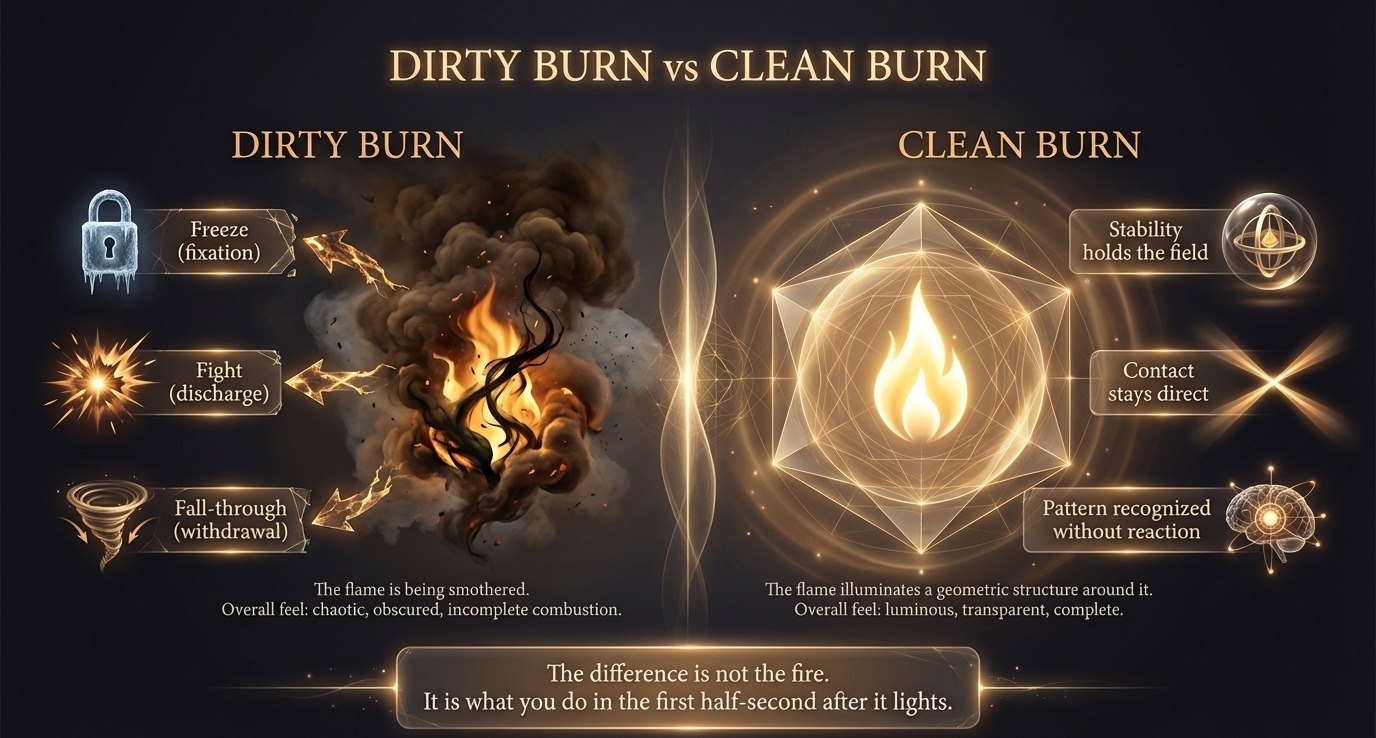
This requires everything the training has been building. Stability — so the field can hold pressure without fragmenting. Contact literacy — so heat is felt directly rather than interpreted prematurely. Pattern recognition — so the mind sees what is destabilizing, not just that something is. And awareness of these very reflexes — so that freeze, fight, and fall-through are recognized rather than enacted.
When these are present, the paradox becomes a crucible. What remains is not a position but a capacity to stay — and in that staying, grasping reveals itself without being replaced by a new architecture.
The fire was never the problem. The problem was what you did in the first half-second after it lit.
Continue learning: Illumination 101
A 10-day course for practitioners who have the maps but haven't yet inhabited the territory.
Start the course →