
The Voltage Problem: Why Your Practice Keeps Stalling
You have been meditating for years. You know the instructions. You have sat retreats, read the books, maybe even had a few genuine openings. And yet your practice keeps stalling out. You sit for a week straight, then miss three days. You touch something real on the cushion, then spend the next month narrating the memory of it instead of returning to it.
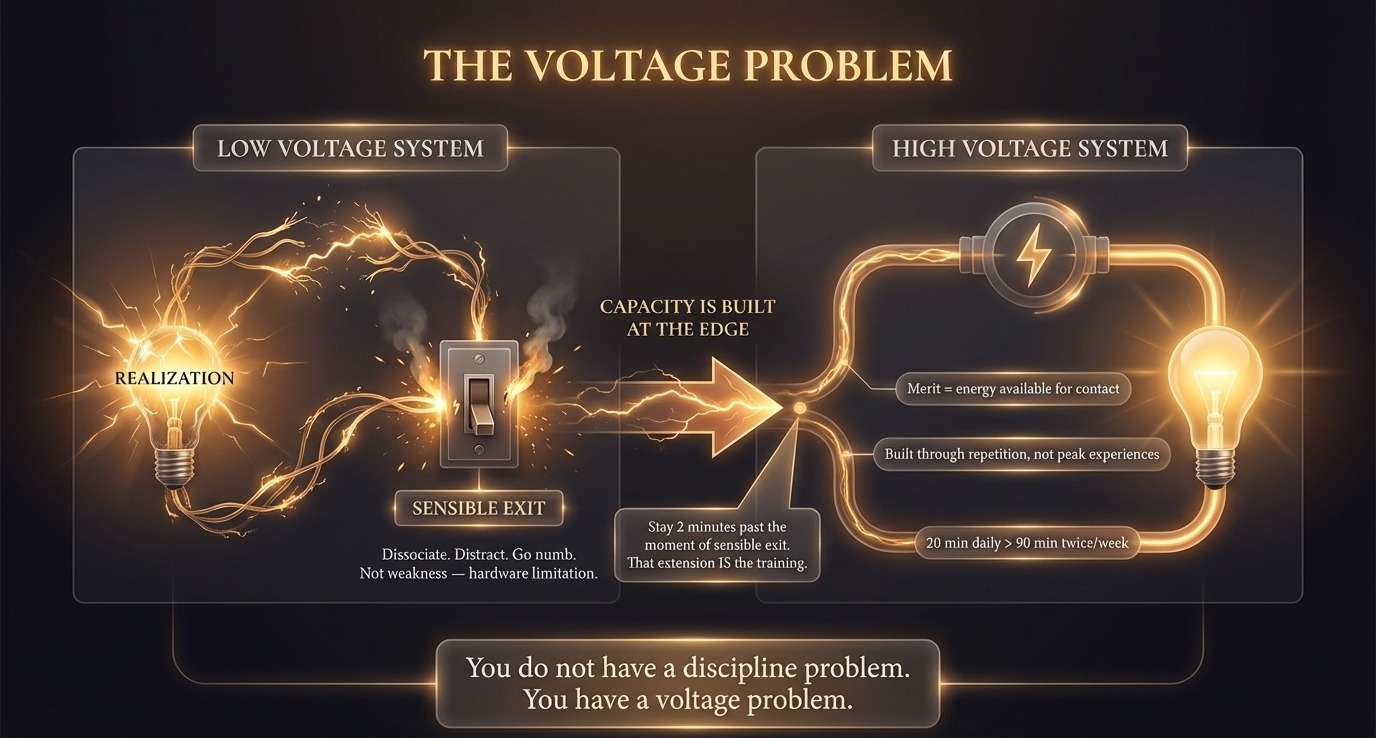
The standard diagnosis is a discipline problem. You need more willpower, more structure, a better accountability system. But here is a different frame, one that might actually be useful: you do not have a discipline problem. You have a voltage problem.
The Hardware Issue
Think of your system as a circuit. Genuine contact with reality -- the kind that actually changes something -- requires a certain wattage. It takes real energy to stay present with what is uncomfortable, to hold attention on something the nervous system would rather escape, to remain in the body when the body is signaling that it would very much like to check out.
Most practitioners are trying to run high-intensity realisations through low-wattage wiring. The circuit trips. They dissociate, distract, reach for the phone, or simply go numb. This is not weakness. It is a hardware limitation being treated as a character defect.
What the traditions call "merit" is not virtue points. In the CC framework, think of it as the amount of energy available to sustain genuine contact with reality. Without sufficient merit, practice goes two steps forward and two steps back. You touch something real, but you cannot hold it. Not because you are doing it wrong, but because the container is not yet built to hold it.
Where the Voltage Leaks
Modern life is a voltage drain. We override the body's signals to function in jobs that require sustained numbness. We consume information at a rate that prevents any of it from landing. We narrate our experience instead of having it -- describing our anxiety with clinical precision while never actually feeling where it lives in the chest.
The specific leak point in practice is the moment of "sensible exit." You are sitting with something uncomfortable -- a tightness, a nagging dread, a quality of boredom that feels like it might swallow you -- and the system says: enough. Time to redirect to the breath. Time to open the eyes. Time to think about dinner.
That moment is not a failure. It is the system accurately reporting that staying would require more energy than is currently available. The exit is sensible. It is also the exact location where capacity is built.
Building the Capacity to Stay
Voltage training is not about forcing yourself through discomfort for its own sake. It is about discovering that the edge of your tolerance is not a wall. It is a threshold. And every time you stay two minutes past the moment of sensible exit, you extend the wiring.
The practice is concrete. Before you sit, identify one thing you habitually avoid -- a background anxiety, a chronic body tension, an unresolved thought you keep batting away. When it shows up on the cushion, do not redirect. Turn toward it. Study it the way you would study something genuinely interesting: its shape, its temperature, its pulse.
When the impulse to escape arises -- and it will, probably dressed up as a reasonable meditation instruction like "return to the breath" -- note the impulse and stay. Not forever. Just two minutes past the moment that feels like enough.
That extension is the training. That is voltage being built. Not discipline. Not willpower. Capacity.
The Reframe That Changes Everything
Once you see inconsistency as a hardware issue rather than a moral failing, the entire orientation shifts. You stop beating yourself up for missed sits and start asking a more useful question: where am I leaking voltage, and what would it take to build the wiring to hold more?
Twenty minutes daily will outperform ninety minutes twice a week. The container is built through repetition, not peak experiences. Do less than you think you should. Do it every day. And when the edge arrives -- when the system says "enough" -- stay two minutes past it.
That is the whole practice. Everything else is commentary.
Continue learning: Illumination 101
A 10-day course for practitioners who have the maps but haven't yet inhabited the territory.
Start the course →