What You Call 'Being Present' Is Still a Performance
You have been told that the answer is to be present. Come back to the moment. Ground yourself in what is happening right now — this breath, this body, this sensation. You have practiced this. You have returned to the breath ten thousand times, noted sensations, scanned the body, anchored yourself in the immediate.
And yet something remains off. The present you keep arriving in feels like another task — another performance, this time under the banner of mindfulness.
The "present" you are returning to is not neutral ground. It is already shaped by everything you bring to it.
The Tilted Moment
When you walk into any situation — a room, a conversation, a meditation session — you do not arrive empty. You arrive carrying your karma: the accumulated conditioning of your preferences, your assumptions, your unresolved patterns, your history. Before you have consciously registered what is happening, that conditioning has already determined how you will relate to it.
This is not a subtle philosophical point. It is mechanically operative in every moment of contact. The same room that one person experiences as exciting, another experiences as anxiety-inducing. Not because the room is different, but because what each person brings to the moment — the conditioning through which they meet it — shapes the vedanā, the immediate feeling-tone, which shapes the perception, which shapes the entire downstream cascade of meaning.
Your "present moment" is already tilted by the time you get there. The question is not whether you are present. You are always present — always absorbed in the generation of experience. The question is what kind of presence you are generating.
The Agreement Structure
"Being present" has become its own agreement structure — collectively held assumptions about what presence looks like. Grounded. Calm. Attentive to body, breath, sensation. A quality of acceptance. This representation is an image assembled from instructions, teachers, and the cultural aesthetic of mindfulness.
When you sit down to "be present," you are often not meeting the actual moment. You are performing an alignment with the image of what meeting the moment should look like.
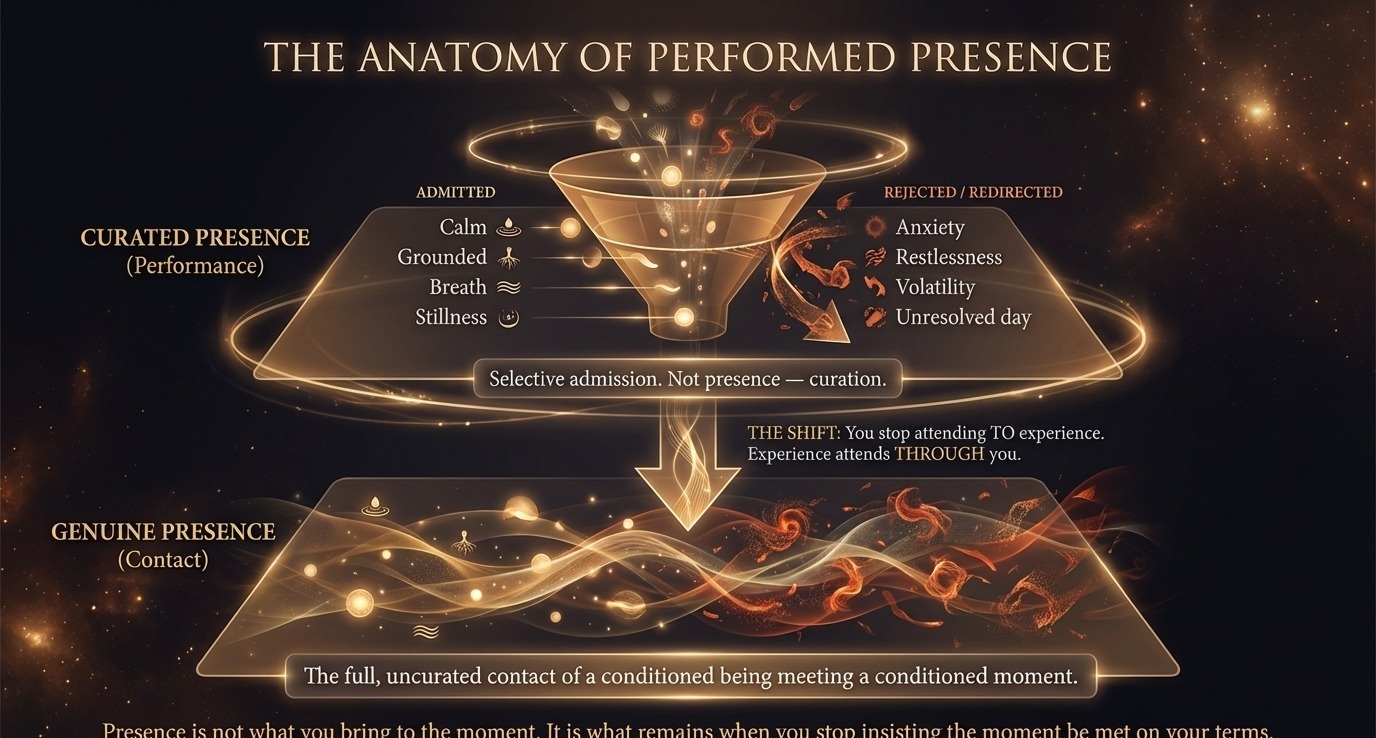
Notice the difference. In one, you are making genuine contact with whatever is here — including the discomfort, the restlessness, the pull of your unresolved day. In the other, you are enacting a posture that selectively admits only what fits the representation. Calm, yes. Anxious, restless, volatile — these get managed, redirected, returned-to-the-breath away.
That selective admission is not presence. It is curation.
Even the Techniques Become Insistence
Body scanning can be genuine reassociation — actually feeling what is here, meeting the body as it is. Or it can become a systematic tour that imposes a particular relationship with sensation, seeking the "right" quality of embodied awareness. Noting practice can be a tool for recognizing the movements of mind. Or it can become compulsive labeling that keeps you one step removed — always naming, never touching.
The technique is not the problem. The problem is when the technique becomes the template you perform rather than the scaffold that serves a deeper intimacy.
You know the difference. When a technique genuinely serves you, there is a quality of opening — willingness to discover what is actually here. When it has become performance, there is a quality of closure — a narrowing toward the predetermined outcome, the feeling you have decided presence should produce.
What You Bring to the Moment
Even without the techniques, even without the performance of mindfulness, you cannot meet the moment as a blank slate. You are a conditioned being whose conditioning is active in the very structure of perception. The bare feeling-tone of this moment — pleasant, unpleasant, neutral — is already conditioned by how you have been meeting moments like this your entire life. Your perception is shaped by habitual categories. Your interpretation is tilted by the narrative you carry about who you are.
This does not mean presence is impossible. It means presence is not the absence of conditioning. It is the willingness to see conditioning at work in real time — to recognize that your "present" is a conditioned meeting with reality, and to hold that recognition without trying to fix it.
What Genuine Presence Asks
Genuine presence is not an achievement of stillness. It is a willingness to stay with the full field — including the parts of you that are performing, curating, and avoiding. It includes the conditioning rather than pretending to transcend it.
The practice is not to "be more present." It is to become honest about what you are actually doing when you claim to be present. Are you meeting the full moment, or the version your conditioning is willing to admit?
When you see yourself performing presence — arranging your attention into the shape of someone who is here — include the performance itself. Let it be part of the field. The genuine article does not look like anything in particular. It is the direct, unglamorous contact with whatever is actually happening — including the impulse to make it look a certain way.
The Shift
There is a moment when the frame inverts. You stop trying to be present to experience and recognize that experience is already holding your attention. The relationship reverses: instead of you attending to experience, experience attends through you.
This is not a technique. It is what happens when the performance exhausts itself — when you finally stop manufacturing and discover what was already here. Not the curated stillness of your mindfulness practice. The full, uncurated contact of a conditioned being meeting a conditioned moment — and finding, in that meeting, a coherence that needed no performance to produce it.
Presence is not what you bring to the moment. It is what remains when you stop insisting the moment be met on your terms.
Continue learning: Illumination 101
A 10-day course for practitioners who have the maps but haven't yet inhabited the territory.
Start the course →