Why Your Analytical Mind Is the Obstacle to Intuition
You can map a phenomenological state in real time, identify the subtle flavor of a contraction before it fully forms, cross-reference your experience against three contemplative traditions before breakfast. Your analytical capacity is genuine. It is also the ceiling you keep hitting.
Here is the pattern: you sit, something opens, and before the opening can deepen into contact, the analytical mind has already arrived with its labels, its frameworks, its satisfied sense of recognition. "Ah, that was a moment of non-dual awareness." And in the naming, the moment is already gone -- converted from lived reality into inventory.
You are not doing anything wrong. You are doing what worked. The problem is that the instrument that got you here cannot take you further.
The Masculine Function and Its Limit
In CC we use the language of masculine and feminine energy -- not as gender categories, but as functional modes of engagement with reality. The masculine function analyzes, discriminates, maps, names. It observes from a slight distance and creates structure. It breaks the meditation into components, identifies the flinch before it fully forms, and builds the conceptual architecture that makes practice intelligible.
This function is not optional. Without it, experience remains undifferentiated mush -- emotional reactivity cosplaying as sensitivity. The analytical function is what separates a practitioner from someone who just has a lot of feelings about meditation.
But the limit is structural: the analytical function can only map what it stands apart from. Its clarity depends on distance. And distance is precisely what prevents the kind of contact where intuition lives.
The Feminine Function: What Analytical Minds Resist
The feminine function does not observe from outside -- it enters. It does not name the experience but becomes continuous with it. Where the masculine function produces knowledge about reality, the feminine function produces contact with reality. It is the felt sense of a relational field before the mind can articulate what it is sensing. It is the body knowing something three seconds before the intellect catches up.
This is what intuition actually is. Not a mystical capacity. Not a personality trait. A mode of knowing that operates through feeling, observation, and embodiment simultaneously -- not sequentially, not as a checklist, but as a single act of contact.
The problem is that this mode cannot be accessed through analysis. You cannot think your way into feeling. You cannot analyze your way into contact. The more precisely you try to observe intuition, the more it recedes -- because precise observation is itself the distance that prevents it.
Analysis maps the territory. Intuition is the territory.
The Dimensions of Intuitive Contact
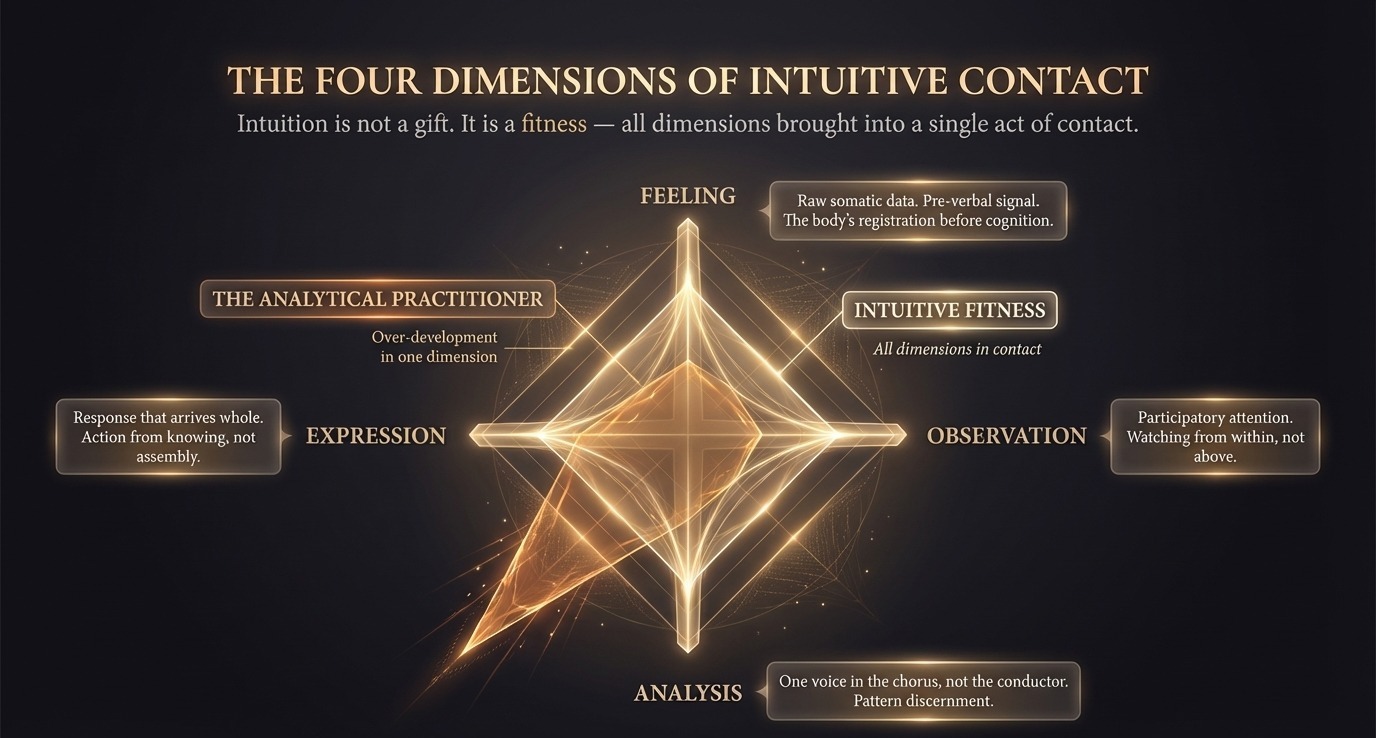
Intuition is not one thing. It is a convergence of four capacities, each of which can be trained:
Feeling -- the raw somatic data, the body's registration of what is present before cognition arrives. Not emotion, but the pre-verbal signal that something in the field has shifted.
Observation -- not analytical observation, but participatory attention. Watching the way energy moves between people, the way a room changes when someone enters it. Watching not from above, but from within.
Analysis -- the analytical mind has its place, but as one voice in a chorus, not the conductor. The capacity to discern pattern and articulate what the feeling already knows.
Expression -- the capacity to translate the first three into action. Not explanation but response -- the decision that arrives whole rather than being assembled from parts.
When these operate in isolation, you get familiar failure modes. Feeling alone produces the person who is "very intuitive" but collapses under scrutiny. Analysis alone produces the person who can map every state but cannot be changed by any of them. Train all four together, and intuition reveals itself not as a gift but as a fitness -- a trained capacity to bring every dimension of contact into a single act.
Why the Analytical Practitioner Gets Stuck
The specific trap for the cerebral practitioner: you have over-developed analysis to the point where it dominates the other three. Your feeling is immediately hijacked by labeling. Your observation is always from the outside. Your expression is careful, precise, and slightly dead -- accurate but not alive.
You can see exactly where you are. You can name the stage, identify the hindrance, prescribe the remedy. And yet nothing moves. The map is perfect. You are standing on it instead of walking through the terrain.
Analysis creates paralysis not because it is wrong, but because it demands certainty before action. Intuition moves in the opposite direction: it acts from a knowing that precedes certainty. The analytical practitioner wants to close the gap between sensing and understanding. The intuitive practitioner learns to inhabit it.
The Training
You do not develop intuition by abandoning analysis. You develop it by building the other dimensions until analysis is no longer the dominant voice.
Train feeling: sit with a sensation and not name it for thirty seconds longer than is comfortable. Let the somatic data exist unprocessed. Train relational observation: notice how energy moves in a room, how your presence changes the field -- not to produce insight, but to develop the sensitivity that makes insight possible. Train expression: speak from the felt sense before the analytical mind has finished its assessment. Tolerate not having the complete map before you open your mouth.
Do all of this not as separate exercises but as a simultaneous practice. This is what we mean by fitness: the capacity to bring all of your faculties into contact with what is actually here. The analytical mind will resist -- it will insist that feeling without analysis is sloppy, that acting without full understanding is reckless. Notice that insistence. The gap between sensing and knowing is where practice lives.
The mind that mapped the path cannot walk it. Put down the map. The terrain is already under your feet.
Continue learning: Illumination 101
A 10-day course for practitioners who have the maps but haven't yet inhabited the territory.
Start the course →