Why Your Insight Keeps Collapsing Into a New Identity
Something dissolved. You recognized — not intellectually but viscerally — that identity is constructed, that there is no intrinsic ground beneath the self you had been maintaining. The insight was genuine.
And then the aggregates kept going.
Contact continued. Feeling-tone continued. Perception continued selecting and labeling. Formation continued shaping responses. The machinery of experience did not pause to acknowledge what you had seen. It simply reorganized — and what it reorganized around was the insight itself.
The Four Distortions
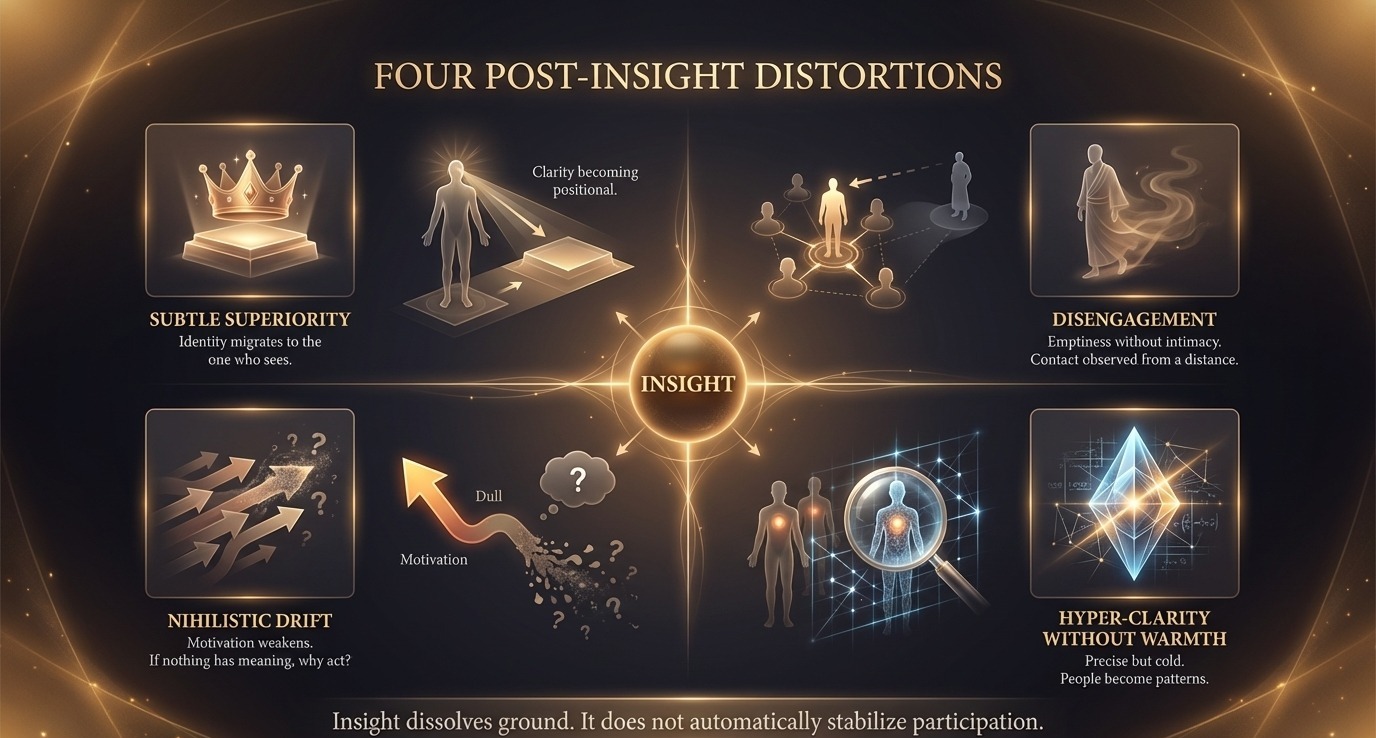
When conceptual ground dissolves but the system still requires orientation, the aggregates reach for the nearest available stabilizer. Four patterns appear with striking reliability — not because the insight was false, but because the system is still organizing around some referential point, just more subtly.
Subtle superiority. The mind recognizes that identity cannot be secured, that reality is empty of intrinsic existence. But the system reorganizes around the one who understands this. A new identity position forms — the one who sees, the one who is no longer caught. Nothing in the content seems incorrect. But clarity has become positional. Identity is now stabilizing around insight itself, and the architecture of self-reference is intact. The intrinsic identity has not disappeared. It has migrated.
Disengagement. If experience is empty, if meaning cannot hold — then relational participation begins to feel unnecessary. Why invest in relationships that are conditioned? Situations that previously carried urgency now feel strangely distant. The field becomes quiet but less alive. The system has discovered emptiness but not yet discovered intimacy. Contact is observed from a subtle distance that feels like spaciousness but functions as withdrawal.
Nihilistic drift. Once intrinsic ground disappears, motivation weakens. If nothing possesses inherent meaning, why act? Energy drains from participation. This is not a philosophical doctrine — it is a psychological adaptation, the nervous system escaping the burden of consequence. But dependent origination tells a different story: if phenomena arise through conditioning, participation becomes more consequential, not less. The absence of intrinsic ground does not remove consequence. It reveals how deeply everything is connected.
Hyper-clarity without warmth. Insight sharpens perception. Identity constructions become obvious, interpretive patterns transparent. But relational warmth does not automatically accompany this clarity. The mind becomes precise but cold. People become patterns. Relationship becomes observation. Contact has lost its composure — not through distance, but through the dominance of analysis over receptivity.
The Structural Gap
What all four distortions share is the same root: insight dissolves conceptual ground, but insight alone does not stabilize participation.
This is the structural gap most contemplative training fails to name. Practitioners assume that once emptiness is recognized, experience will automatically reorganize. It does not.
The aggregates are governed by conditioning, not insight. Even after recognizing emptiness, perception biases remain, emotional reflexes remain, habitual responses remain. You may see clearly that identity is constructed and still react defensively in conversation.
This lag is not hypocrisy. It is structural. Insight belongs to recognition. Conditioning belongs to momentum. Momentum does not dissolve because recognition occurred.
Virtue as Structural Composure
If insight alone cannot regulate the aggregates, what can?
The answer is virtue — but not as the word is usually understood.
Virtue, in the sense that matters here, is not moral instruction. It is not a system of rules governing conduct. Virtue is the composure of participation when identity is not defending itself.
Consider patience. A person can remain silent for an hour while boiling with resentment. Another can interrupt quickly but without hostility. The duration tells you nothing. Patience is the absence of friction in the encounter. Generosity is the absence of possessiveness in participation. These are not measured by behavior but by the composure of contact.
These are not behaviors to perform. They are qualities that naturally accompany awakened functioning — the way light accompanies the sun. From the perspective of the path, they must be cultivated because conditioning still obscures them. But they are not added from outside. They are what appears when distortions thin.
The Pāramitās as Ecology
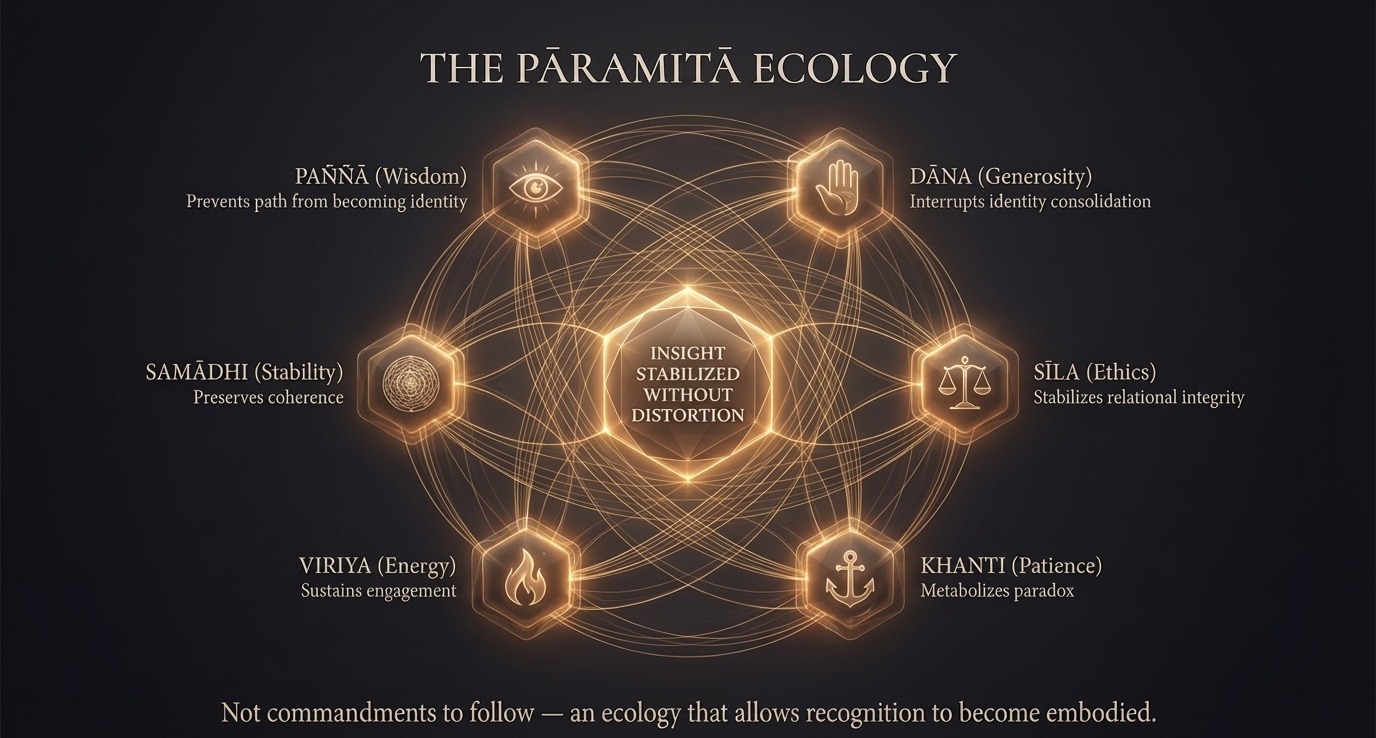
The pāramitās — the perfections — are not a checklist. They function as an ecology, each one addressing a specific distortion that arises when insight meets conditioning that has not yet caught up.
Dāna — generosity — interrupts identity consolidation around insight. When clarity flows rather than accumulates, identity has nowhere to stabilize.
Sīla — ethical composure — stabilizes relational integrity, ensuring that contact remains clean rather than manipulative or self-referential.
Khanti — patience — metabolizes paradox, allowing tension to remain without collapsing, restoring warmth to clarity that has become cutting.
Viriya — energy — sustains engagement when the system would otherwise drift into disengagement or nihilistic collapse.
Samādhi — meditative stability — preserves coherence, holding the field steady enough for virtue and wisdom to function together.
Paññā — wisdom — prevents the entire path from becoming another identity structure. Even virtue can become attachment. Wisdom dissolves that fixation by recognizing that none of these qualities belong to a self.
Together, they create the conditions under which insight stabilizes without distortion. Not commandments to follow, but an ecology that allows recognition to become embodied.
Where View Becomes Real
Insight does not free you from consequence. Insight frees you from ignorance about consequence.
Dependent origination, conditioning, relationship — all of this continues. Every moment of contact reshapes the field. Every response conditions future experience. Responsibility does not decrease. It becomes unavoidable — not as the burden of a self shouldering the world, but as the responsiveness of a system that sees it is inseparable from the world.
The question changes. It is no longer what is true but how do you participate — knowing what you know, seeing what you see. Participation is the only place where view can stabilize. Not in theory. Not in memory. In the next moment of contact, the next response, the next relationship.
Awakening does not end the question. It relocates it — from what you know to how you meet what is here.
Continue learning: Illumination 101
A 10-day course for practitioners who have the maps but haven't yet inhabited the territory.
Start the course →