
You Don't Have a Letting-Go Problem
Surrender. Let go. Release. You have heard these instructions so many times they have become furniture — something you walk past without seeing. And the reason they have lost their force is not that they are wrong. It is that they have become platitudes obscuring a mechanism nobody bothered to explain.
What, exactly, are you letting go of? Your thoughts? Your preferences? Your desire to have a good life? If you let go of everything, do you just sit there like a stone? And if the answer is "no, not that kind of letting go," then what kind?
The instruction has collapsed into vagueness. And vagueness, in practice, is not neutral. It is actively misleading.
The Mechanism of Insistence
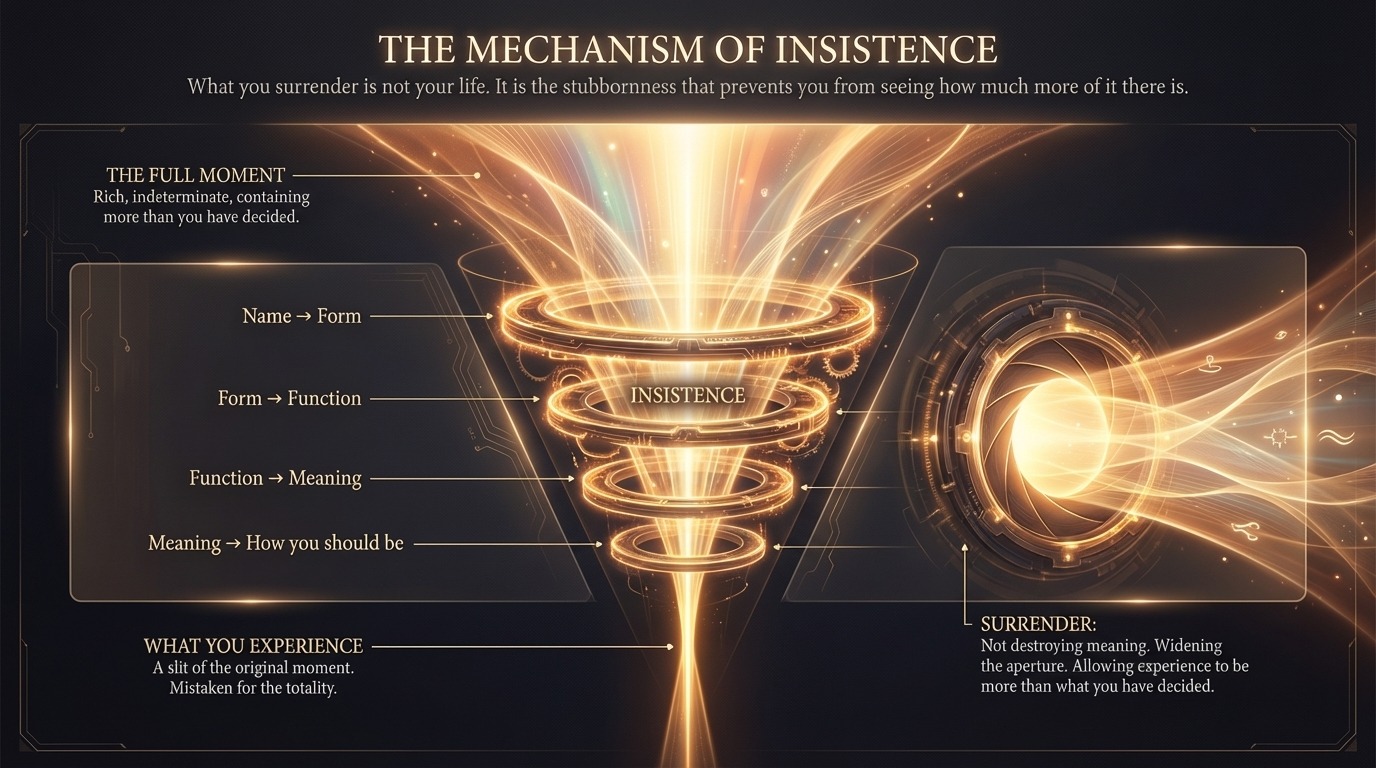
Here is what is actually happening. You are not clinging to experience. You are clinging to your determination of what experience is.
You walk into a room. Before you have consciously registered anything, you have already decided: this is an office, that is a colleague, this interaction will be boring, I should be somewhere else. These decisions are not reflective. They are reflexive — the conditioned momentum of a lifetime of orienting through representation. Name to form, form to function, function to meaning, meaning to how you should be.
None of that is a problem. It is how a mind navigates. The problem begins when you insist that these determinations are complete — that the room is only an office, the colleague is only what your story makes them, and the moment can only mean what you have decided it means.
That insistence is the clinging. Not clinging to the room or the colleague or the moment, but clinging to the insistence that they cannot be otherwise.
What Surrender Actually Means
Surrender is not the destruction of meaning. It is not nihilism dressed up in spiritual language — the shrug that says nothing matters, we are all stardust, why bother. That is just insistence of a different flavor.
Surrender is the releasing of the tight grip your determinations have on the range of what experience is allowed to be.
You are having a fight with your partner. You have decided: they are angry, this is unfair, they never try to understand. And from within that determination, every piece of evidence you encounter gets sorted into the existing architecture. Their tone confirms your interpretation. Their words validate your narrative. Even their silence becomes proof.
But what if you loosened the grip — not on your perception, which is real, but on your insistence that your perception is the totality of what is happening? What if you allowed for the possibility that this person you care about had a day you know nothing about? That their anger is not just about you? That the moment contains more than the story you have already decided it tells?
This is not about being passive. It is not about letting people walk over you. It is about recognizing that your interpretation, however valid in its own frame, is structurally incomplete — and that the suffering you feel is generated not by the situation but by your refusal to let it be anything other than what you have determined.
The Exhaustion of Holding It Together
You know this feeling. The constant low-grade effort of maintaining your version of reality against the feedback the moment is actually giving you. You carry it everywhere — into work, into relationships, into your practice. The sense that if you let up for one second, something will fall apart.
And you are right. Something will fall apart. The architecture of your insistence will fall apart. The story that needs constant maintenance, the identity that requires constant validation, the coherence that depends on you actively suppressing any evidence that contradicts it.
What will not fall apart is experience itself. Experience does not need your insistence to cohere. It was cohering before you started insisting. It coheres in your sleep, when the management structure goes offline. It coheres in those rare moments when you forget to hold it together and discover, briefly, that nothing collapsed.
The exhaustion you feel is not the exhaustion of living. It is the exhaustion of insisting that living be a particular way.
The Invitation
So when the instruction says "let go," it is not asking you to stop having preferences. It is not asking you to become indifferent or passive or emptied of perspective. It is asking something far more specific and far more demanding.
It is asking you to notice the moment when your determination of what something is hardens into the insistence that it can only be that. And to soften there. Not to adopt the opposite view — that is just the same insistence facing the other direction. Not to reach for some middle ground — that is still negotiating. But to allow the moment to be indeterminate long enough that you can actually meet it.
This takes practice because it is antithetical to your conditioning. You have been trained — by biology, by culture, by survival itself — to determine quickly and act decisively. That training kept you alive. It also narrowed the aperture of your experience to a slit.
The practice does not ask you to discard the aperture. It asks you to widen it. To come into each moment carrying your preferences, your history, your karma — all of it — and to recognize that what you bring is not the totality of what is here.
Letting go is not something you do. It is the permission you give experience to be more than what you have decided.
What you surrender is not your life. It is the stubbornness that prevents you from seeing how much more of it there is.
Continue learning: Illumination 101
A 10-day course for practitioners who have the maps but haven't yet inhabited the territory.
Start the course →