
Your Attention Is Not Broken
You sit down to meditate. Within thirty seconds, you are somewhere else — replaying a conversation, rehearsing tomorrow's meeting, following a chain of association so far from where you started that when you "come back," you cannot trace the route. You diagnose the problem: my attention is broken. I cannot focus. Something is wrong with my mind.
Nothing is wrong with your mind. Your attention is doing exactly what it was trained to do.
The Conditioned Vector
Attention does not wander randomly. It moves along conditioned vectors — grooves carved by years of reinforcement, preference, avoidance, and desire. When you sit down and your mind lurches toward your to-do list, that is not a failure of concentration. It is the gravitational pull of a deeply conditioned pattern expressing itself.
You have spent your entire life training these vectors. Every notification you respond to reinforces the circuit that says new stimulus requires immediate attention. Every uncomfortable feeling you redirect toward analysis deepens the groove that routes sensation through narrative. And then you sit on a cushion and expect that system to behave differently because you have changed the context.
Attention does not care about context. It follows the grooves.
Papañca: The Default Setting
In the Pali canon, this proliferative movement of mind is called papañca — conceptual proliferation. It is the tendency of mind, at the moment of contact with any experience, to elaborate. Contact becomes feeling-tone. Feeling-tone becomes perception. Perception becomes narrative. Narrative becomes identity. And suddenly you are not sitting in a room — you are living inside a story about who you are, what you should be doing, and why this moment is not the right one.
Papañca is not a malfunction. It is the default operation of a conditioned mind — wired by the cumulative pressure of an environment that rewards rapid categorization and relentless productivity. You are a system optimized for exactly this: the instant conversion of contact into meaning, meaning into action, action into more contact.
The meditator who sits down and finds their mind proliferating is not failing. They are seeing, for the first time, the speed and automaticity of a process that runs constantly but is usually invisible because you are lost in its output.
You Cannot Fix Conditioned Attention with More Conditions
Here is where most practitioners go wrong. They diagnose the problem as insufficient concentration and prescribe more concentration. More effort. Tighter focus. A better technique.
But adding conditions to fix a conditioned problem preserves the structure of the problem. If your attention is scattered because it follows conditioned vectors, forcing it onto a single object is just adding a new vector — a new groove labeled "correct meditation" that competes with the existing grooves. You can white-knuckle your way to temporary stillness, but the moment the grip loosens, the old vectors reassert themselves. Nothing has changed except the amount of effort required to maintain the appearance of calm.
This is why the instruction is not "concentrate harder." The instruction is: see the movement itself.
When attention lurches toward the to-do list, the practice is not to yank it back to the breath. The practice is to notice that a lurch happened. To recognize the vector — the conditioned pull — without following it and without fighting it. To let the gravity well of that particular pattern become visible rather than invisible.
The Gravity Well
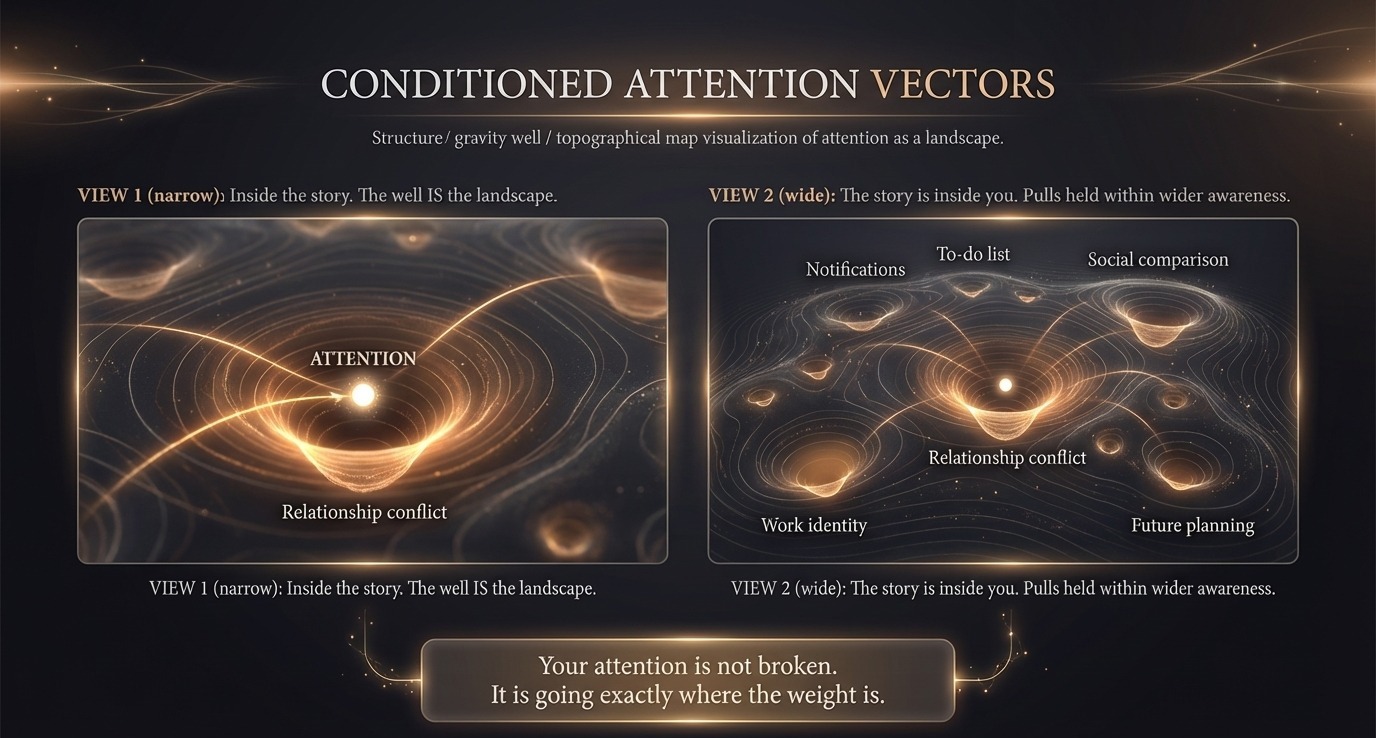
Your attention operates like a gravity well. Objects of desire, concern, identity — these have mass in the economy of your mind. The more you have invested in something, the stronger its gravitational pull on attention. This is why you cannot stop thinking about the conversation with your partner. Not because your mind is weak, but because that relationship carries enormous psychological mass. Your attention is not broken. It is accurate. It is going exactly where the weight is.
The practice is not to make the weight disappear. It is to widen the field of awareness so that the gravity wells — all of them — become part of a larger landscape rather than the landscape itself. When attention is allowed to settle on the entire field rather than being captured by any single well, something shifts. The pulls are still there. The desires, the anxieties, the narratives. But they are held within a wider attention rather than hijacking it.
This is the difference between being absorbed into a single vector and being present to the whole field of vectors. In the first, you are inside the story. In the second, the story is inside you.
What Is Actually Being Trained
You are not training your attention to be still. You are reconditioning the way you participate in the movement of attention itself.
When you come into a session, you bring the momentum of your entire life — every preference, every unresolved vector of becoming. The training is not to override the patterning but to choose differently within it.
This choosing is subtle. Not a forceful redirection but the decision, made again and again, to not invest in the direction the conditioning pulls. To allow the pull and choose not to follow it. To let attention settle rather than chasing it down every corridor your conditioning has built.
Each time you recognize the vector and do not follow it, you recondition the system — not through force but through a different kind of participation. This is what it means to change how you are becoming: not to stop becoming, but to become consciously rather than automatically.
The reps matter. You will be captured by the grooves ten thousand times. The practice is not to never be captured. It is to shorten the distance between gone and here.
Your attention was never broken. It was faithful — to a set of instructions you never chose. The practice is not repair. It is a rewriting of the instructions, one conscious moment at a time.
Continue learning: Illumination 101
A 10-day course for practitioners who have the maps but haven't yet inhabited the territory.
Start the course →