Your Mind Is Making Meaning Out of Thin Air
Look at any object in your room. A coffee cup, a doorframe, a shadow on the wall. Before you can register what you are seeing, your mind has already layered it with story. Name, function, emotional texture. You do not experience the object. You experience the meaning you have draped over it -- and the draping happened so fast you mistook the fabric for the thing itself.
This is the basic operating system of your cognition. And if you have been practicing for any length of time, it is almost certainly the mechanism you have been least willing to look at directly.
The Lens Before the Looking
In classical Buddhist psychology, the word for this is saṅkhāra -- formation, fabrication. It points to the mind's compulsive activity of constructing interpretive frameworks before experience arrives. Not after. Before. The lens is already in place when you open your eyes.
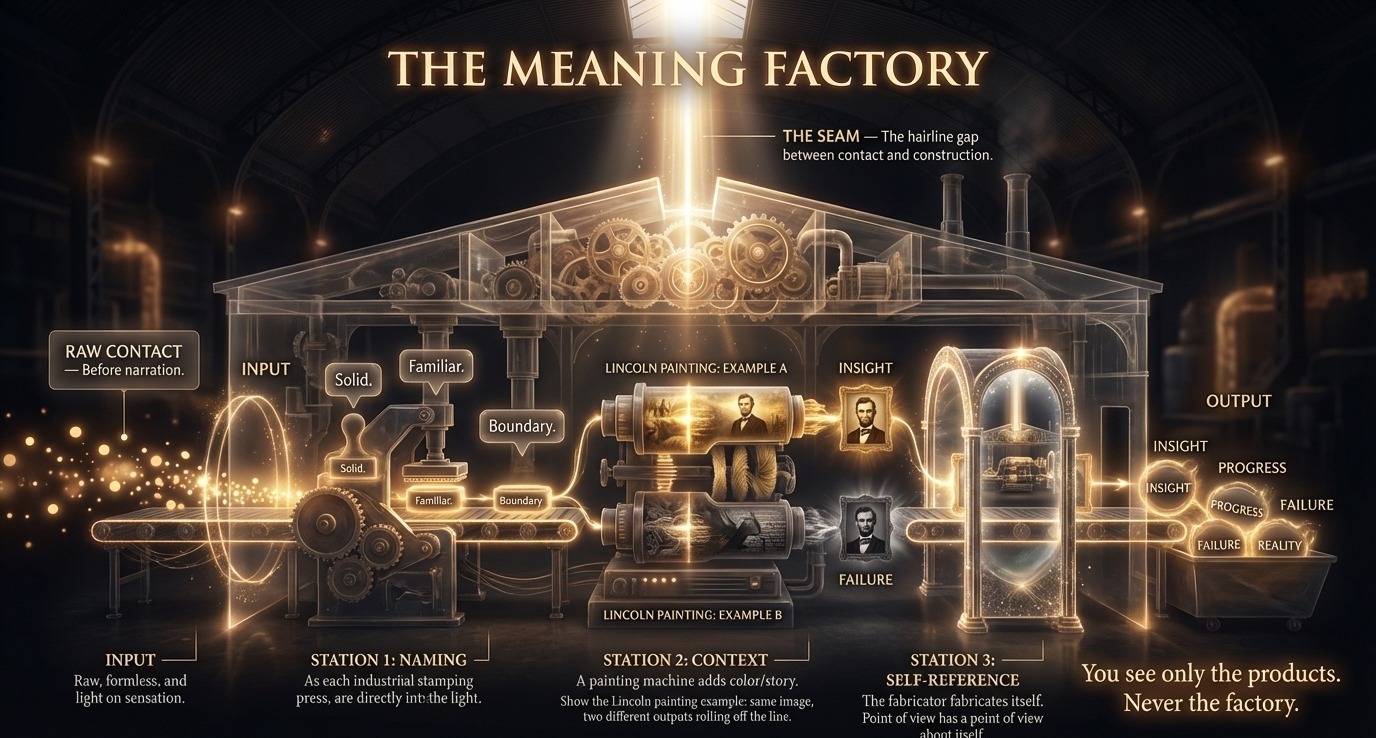
You see a painting of a boy reading by firelight. Cozy. Rustic. Humble. Your mind produces a mood, an entire world, in seconds. Then you learn the boy is Abraham Lincoln. Suddenly the painting means something else entirely. Empire. Destiny. Calm before the storm. The brushstrokes have not changed. What changed is the formation -- the interpretive architecture your mind constructed and reconstructed without being asked.
You did not choose to re-interpret the painting. The new meaning arrived the instant the new context did, like a reflex. The formation happened to you, and you experienced it as seeing more clearly -- as if the second interpretation were truer than the first. Was it? Or was it just a different fabrication, equally contingent on a context handed to you from outside?
The Factory You Cannot See
The problem is not that you make meaning. Meaning-making is as fundamental as breathing. The problem is that you do not see the factory. You see only the products rolling off the line, and you take each one as a direct report from reality.
You sit down. Stillness arises. The mind says: this is progress. A formation. Restlessness follows. The mind says: I am regressing. Another formation. You read about emptiness and the mind constructs a view: reality is ultimately void. That view becomes the lens through which you interpret every subsequent sitting -- and you call that lens "insight."
What you are calling insight is often just a new fabrication that flatters the previous one.
Most formations are so mundane you would never question them. The sense that you are a person having an experience. The feeling that time is moving forward. The conviction that your practice is a project with a beginning and an end. All constructed -- assembled by a process that predates your ability to observe it.
The Conspiracy of Self
Once you notice fabrication in the small things, the same pattern reveals itself in the largest thing: the sense of self.
The self is not a single fabrication. It is a cascading series of formations, each referencing the last, each generating the next. A point of view arises, and before you can examine it, that point of view has already produced a point of view about itself. The reference point has a reference point. The lens is looking through another lens it manufactured a millisecond earlier.
This is why self-inquiry feels like chasing your own tail. You turn to look at the one who is looking, and what you find is another construction -- convincing, coherent, furnished with explanations for its own existence. The self functions perfectly well. But it is emergent, codependent, contingent. From one angle, clearly here. Shift the angle, and it dissolves. The fixation on either view is the problem.
The Resistance
If formations are happening at the speed of cognition -- if your point of view is itself a product of fabrication -- then what exactly are you standing on?
Practitioners approaching this recognition tend to do one of three things. They double down on a familiar view, clinging harder to whatever framework made them feel oriented. They fabricate a counter-view -- "everything is empty" -- which is just another formation in different clothes. Or they dissociate, mistaking blankness for freedom. All three are exits from the recognition rather than ways of resting with it.
Your reference point has no reference. The foundation you built your practice on is floating in midair.
The temptation is to scramble for ground, to grab the next compelling interpretation and call it home.
The practitioner's task is not to stop fabricating. It is to catch the fabrication in the act -- and to discover that what remains when you stop clinging to any particular formation is not chaos. It is openness.
The Practice
You do not need a special technique. You need a willingness to be wrong about what you are seeing -- repeatedly, without panic.
Look at a wall. Notice the mind's immediate narration: solid, familiar, boundary. Now ask -- as genuine inquiry, not philosophical exercise -- what is here before that narration? What is the raw texture of contact before the factory stamps it with a label?
You will not hold this for long. The machinery is fast and habituated. A new interpretation arrives within seconds. The point is not to achieve some meaning-free state. The point is to see the seam -- the hairline gap between contact and construction, between what arrives and what you make of it.
Every time you catch that gap, something shifts. Not because you have achieved a superior view, but because you have seen that all views are constructed. The grip loosens -- enough to recognize fabrication in real time rather than only in retrospect.
That recognition is not a belief. It is a fitness. Built through repetition, not revelation.
Meaning is not discovered. It is fabricated. And the one who fabricates it is also fabricated. See that, and you are no longer trapped in the factory -- you are the space in which it operates.
Continue learning: Illumination 101
A 10-day course for practitioners who have the maps but haven't yet inhabited the territory.
Start the course →