Your Personality Is a Pattern That Learned to Call Itself a Person
You wake up and the world already has a flavor. Before a single thought forms, before your feet hit the floor, there is a temperature to things — an emotional climate that was there before you arrived. You did not choose this. It was waiting for you.
That climate is not random. It is the residue of a feedback loop that has been running so long you have mistaken it for the weather.
Three Loops, One Felt Sense
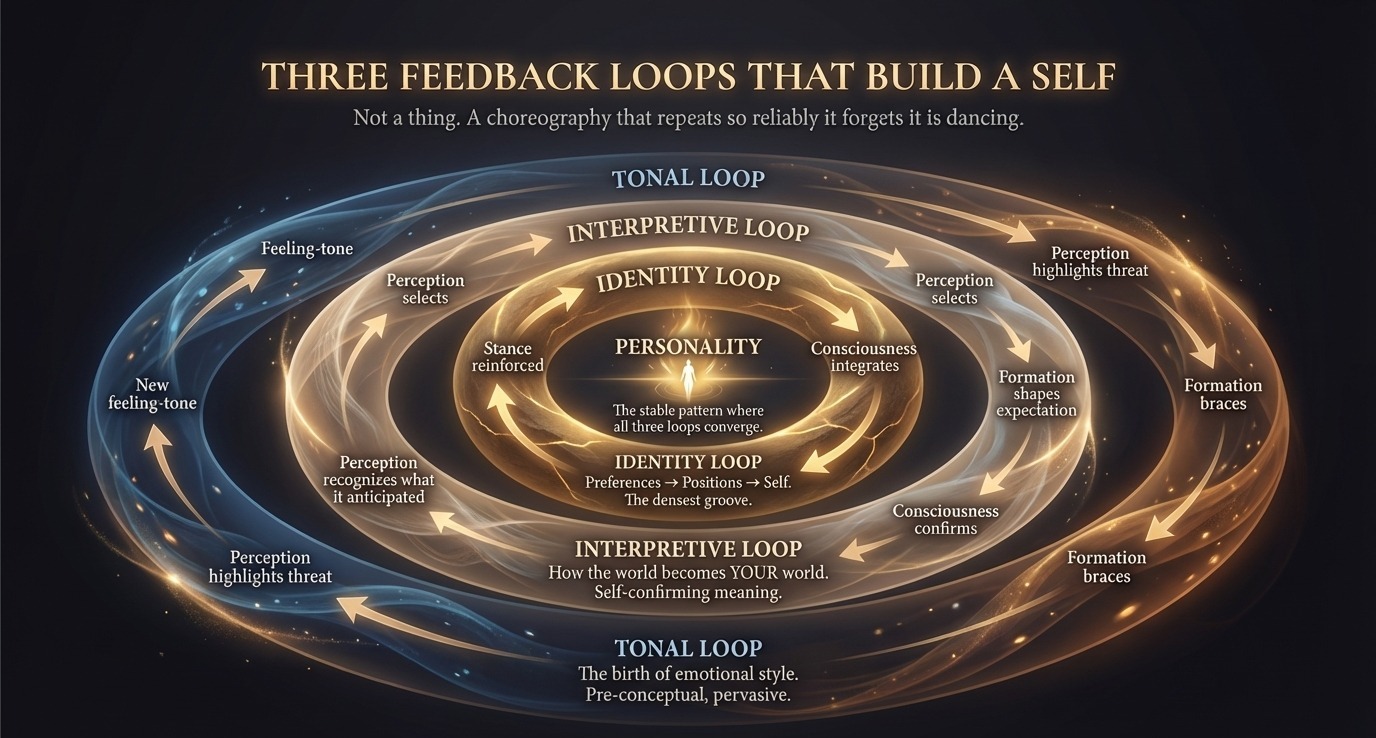
Experience self-organizes into recursive patterns — loops that feed back into themselves, generating continuity. Three of these loops, running simultaneously, produce what you experience as a self.
The tonal loop is the most primitive. A feeling-tone arises — unpleasant. Perception highlights threat. Formation begins bracing, self-protecting. That preparation itself generates another unpleasant tone. The loop closes. This is the architecture of a mood that extends across time — a feedback cycle of leaning. It carries the quality of water: pervasive, pre-conceptual, felt before it is comprehended. This is the birth of your emotional style.
The interpretive loop establishes the logic. Perception picks out a feature of experience. Formation shapes it into expectation. Consciousness lights up the moment as coherent with that expectation. Perception recognizes precisely what it anticipated, and the loop closes. This always happens. People are like this. These are not beliefs arrived at through careful reasoning. They are an interpretive ecosystem — a self-confirming circuit that explains why the same event looks different to different people, why the mind sees what it already knows how to see. This loop moves with the sharpness of air: it discriminates, evaluates, propagates meaning. This is how the world becomes a world rather than a stream of impressions.
The identity loop is the deepest. Formation generates a habitual stance — I am the one who manages, who withdraws, who performs. Consciousness integrates experience through that lens. Contact becomes selective: only certain phenomena register as significant. That selective contact reinforces the original stance. I am the competent one. The anxious one. The spiritual one. These are not stories the mind tells. They are architectural grooves in the riverbed of being. This loop has the density of earth: it converts preferences into positions, positions into self-stands, self-stands into who I am.
The Choreography, Not the Dancer
A personality is what these loops look like when they repeat long enough to be predictable.
Not a substance. Not an essence. A stable choreography of aggregate waves — tonal stances, interpretive frameworks, identity positions — all resonating together, recreating the same temporal architecture moment after moment. The self is a whirlpool in a river. It has recognizable form. It has stability. But it has no existence apart from the water that constitutes it. Remove the current, and the whirlpool does not go somewhere else. It was never a separate thing.
This is why identity feels so solid. The system recreates the same loops moment after moment: past momentum conditioning the present, the present anticipating the future, the future presupposing the past. A thought feels like my thought not because there is a metaphysical "I" owning it, but because the architecture arises continuously. The loop binds the three times into a single gesture, and that gesture is what you call your life.
Where the Loops Overheat
These loops run until something interrupts them — and that something is contradiction.
When emotional tone does not match the present moment, the tonal loop overheats: turbulence, a felt sense that something is off. When meaning conflicts with new information, the interpretive loop overheats: the ground shifting under a previously stable explanation. When identity cannot accommodate lived experience, the identity loop overheats: rigidity, the compression that comes from gripping what can no longer hold.
We feel this as tension, dissonance, the sensation of being caught. The system is trying to maintain a pattern that no longer reflects what is actually happening. This heat is not a problem. It is diagnostic — the point where the architecture becomes visible precisely because it is failing.
Fire does not burn away the loop — that would be nihilism. Fire reveals the loop's architecture by increasing the intensity of its motion until it becomes visible. The pattern can no longer hide in its own smoothness. Its borders — previously invisible because they were the borders of your entire world — now have edges you can feel.
This is purification: the loop exhausting its capacity to hide its own pattern.
Fractal All the Way Down
There is one more thing that makes this architecture difficult to see. The mind operates at multiple scales simultaneously.
A single loop is a particle within a larger pattern of loops. A pattern is a particle within the three times. The mind zooms into the smallest determinacy and out to the widest continuity, and both reveal the same architecture. A moment can reveal a lifetime. A gesture can reveal a worldview. A single tightening in the chest can reveal an entire identity loop.
This is what makes the self so convincing. It is fractal — the same choreography repeating at every magnitude. Each part already contains the signature of the whole.
What Opens
None of this means identity is an illusion to be destroyed. The whirlpool is real — it shapes the river's flow, it has causal force. But it is not what it takes itself to be. It is not a thing apart from the current. It is the current's most stable expression.
Once you can see the choreography, the loops do not vanish. But they lose their unconscious authority. The grooves are still there, but the river is wider than the grooves.
The self is not what you are. It is what being does when it forgets it is moving.
Continue learning: Illumination 101
A 10-day course for practitioners who have the maps but haven't yet inhabited the territory.
Start the course →